
Some bills only show up once or twice a year, and they always seem to arrive at the worst time. Tuition. The car registration. The family trip you've been talking about since spring. Goals are how you see them coming.
A goal is an amount and a date
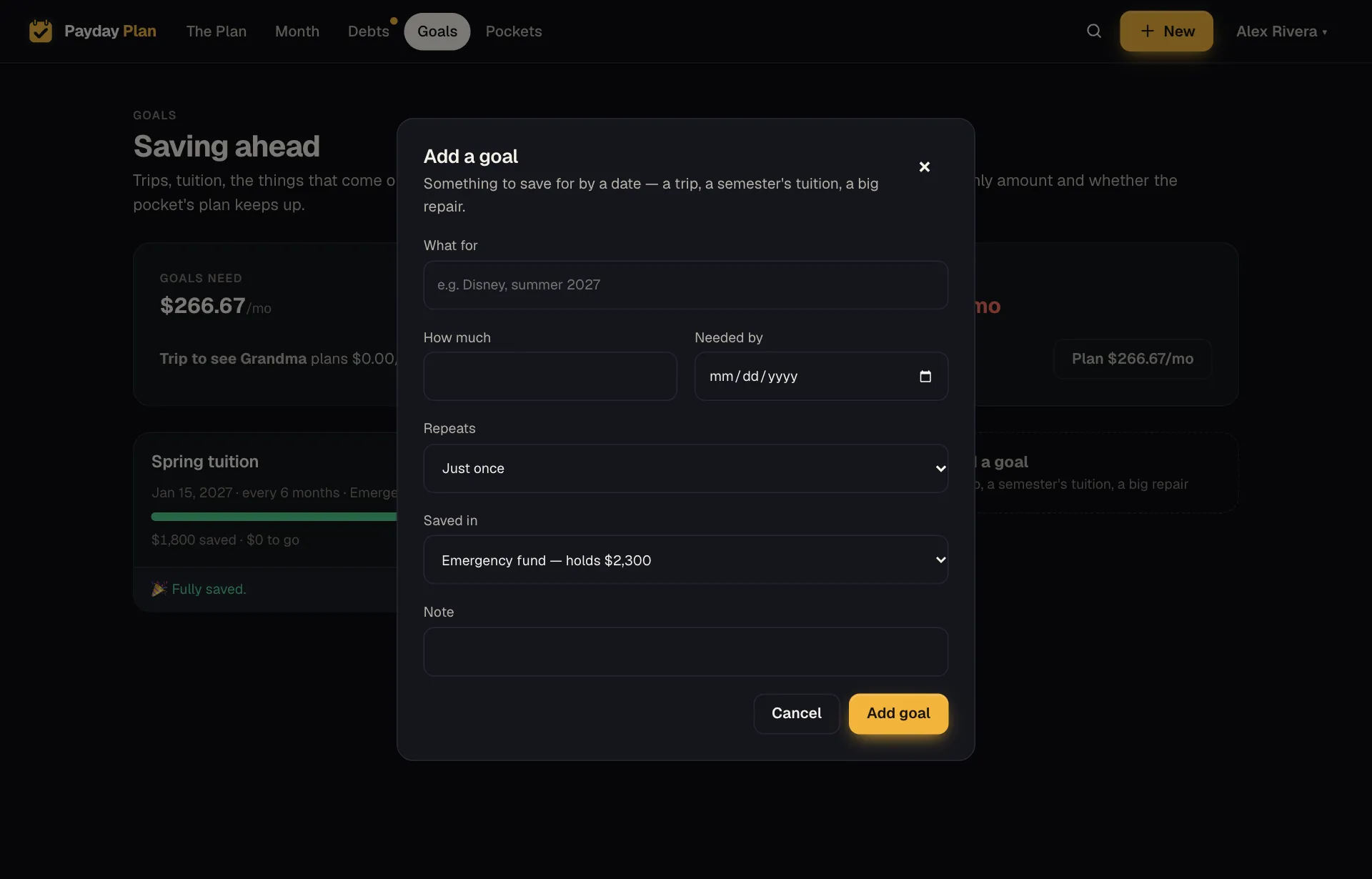
Give it a name, how much, and when you need it by:
We're saving $2,400 for a trip to see Grandma by next July.
Saving $1,800 for spring tuition by January, every 6 months.
Car registration, $310, every March.
A goal can be one-time (the trip) or repeating (tuition each semester, registration every year). Each one lives in a savings pocket, the same pockets you already use for the rest of the plan.
Type it into the box on The Plan, or use Add a goal on the Goals page: What for, How much, Needed by, Repeats, and Saved in (an existing savings pocket, or A new savings pocket…). Either way you see it before it's saved.

What it works out for you
For each goal, Payday Plan shows:
- How much is already set aside, from what's in its pocket.
- What it needs each month from here, counting this month: what's left to save, divided by the months remaining.
- What the pocket is getting each month, from its plan.
- Whether it's on pace, or how far behind it is per month.
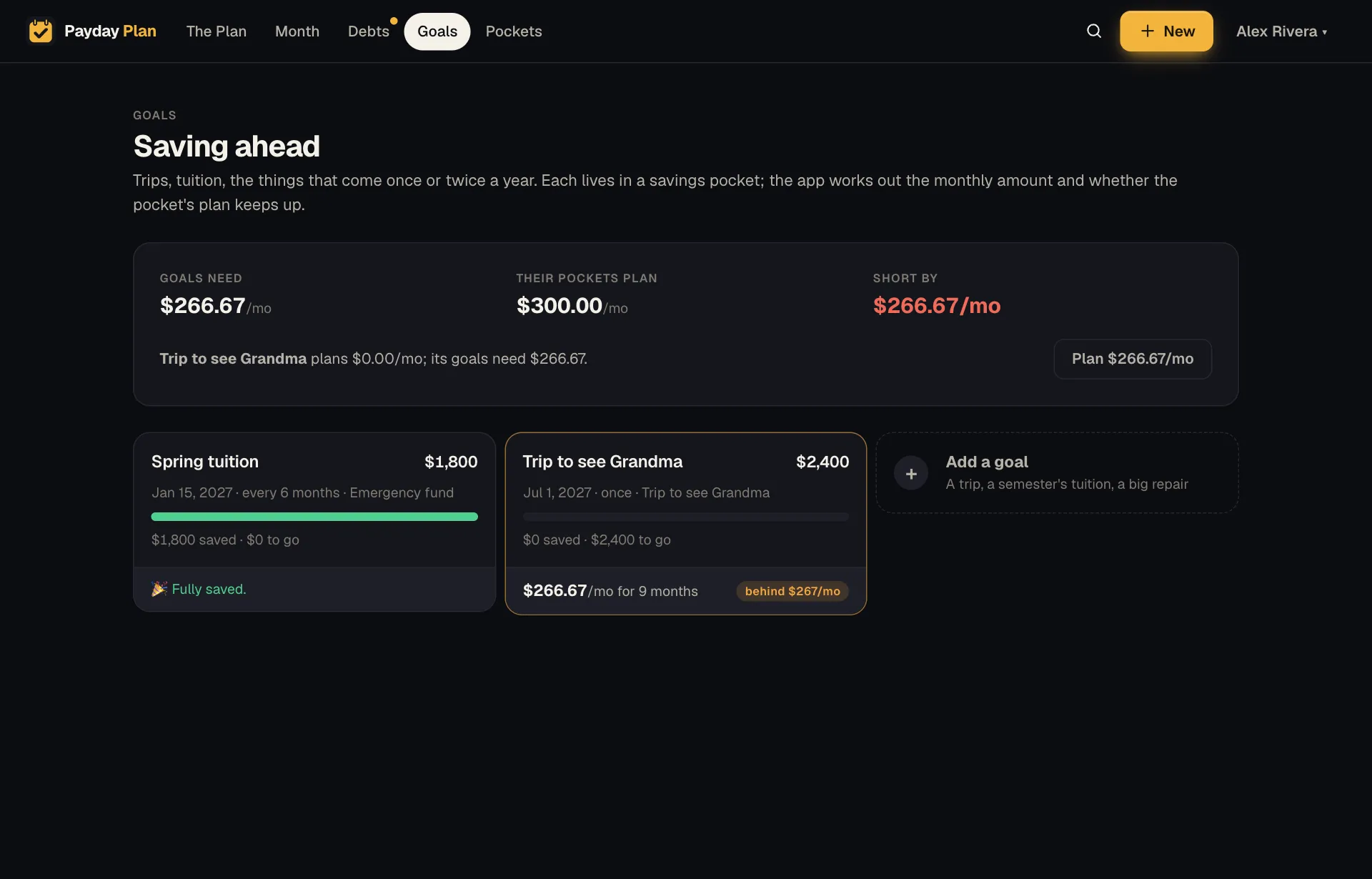
With the example above, a $2,400 trip eight months away with $400 already saved needs $250 a month. If the pocket's plan sends $200, the goal says it's $50 a month behind. (Illustrative numbers. Your trip may involve fewer grandmothers.)
When goals share a pocket
You don't need a separate pocket for every goal. If a pocket holds several, its money is handed out soonest-due first. The March registration is funded before the August vacation, and if the pocket is planned short, you can see exactly which goal feels it.
One click to catch up
If a pocket isn't keeping up, the panel at the top of Goals shows Short by, and a button like Plan $266.67/mo raises that pocket's monthly plan to what its goals need. Nothing else to recalculate. The Pockets page will then show whether your paychecks and Autopilot rules actually send that much to the pocket. If not, that's the next thing to adjust.
Repeating goals roll themselves forward
When a repeating goal's date passes, it rolls forward a cycle on its own. Tuition paid in January becomes tuition due in August. You don't have to remember to recreate it.
A one-time goal whose date has passed is flagged instead ("The date has passed."), so someone can press Mark done or move the date.
Try it: Think of the last bill that made you say "oh, right, that's this month." Make it a repeating goal now, and next year it won't be a surprise.
Where goals show up
- On the Goals page, with each goal's progress and pace.
- On the Pockets page, in the coverage check: do your savings pockets plan enough each month to reach their goals on time?
- On your calendar, if you've added the private calendar link. Each goal date is there alongside bills and paydays.
- After your debts are gone. Once every interest-bearing debt is paid off, a freed payment can go to the goal that's furthest behind.
Saving, not investing
Goals are about setting money aside in a savings pocket so it's there when the date arrives. Payday Plan doesn't pick investments or tell you how much you should be saving. It does the arithmetic on the goals you choose, and keeps it in front of you.