There's a particular satisfaction in killing off a small balance. The sofa plan with fourteen payments left. The phone on a 0% installment plan. You've got a bit of spare money, the balance is right there, and clearing it would mean one less thing on the list.
It feels like the responsible move. It usually isn't.
A 0% plan is the cheapest money you will ever borrow. It costs nothing to keep. Paying it off early hands that free money back, and the dollars you used could have been saving you real interest somewhere else, or sitting in savings ready for an emergency.
The arithmetic
Extra money put toward a debt saves you the interest that debt would have charged on it. That's the whole return.
- A dollar paid early on a 24% card saves you 24% a year on that dollar.
- A dollar paid early on a 7% car loan saves 7%.
- A dollar paid early on a 0% plan saves 0%.
So the 0% plan comes last in line for extra payments, every time. Not because it doesn't matter, but because paying it faster earns nothing.
A worked example
A made-up household has $1,400 left over after a good month, plus these debts:
| Debt | Balance | APR | Payment |
|---|---|---|---|
| Sofa plan | $1,400 | 0% | $100 a month, 14 months left |
| Credit card | $3,000 | 22% | $120 a month |
Option one: clear the sofa. The $1,400 wipes it out. Interest saved: $0. The card carries on at 22%.
Option two: put it on the card. The card drops to $1,600. Interest on that $1,400 would have been about $1,400 × 22% ÷ 12 ≈ $25.67 in the first month alone, and, if that part of the balance would otherwise have sat there for a year, something like $300 or more over the year. The sofa plan carries on at $100 a month, costing nothing, and finishes on schedule.
Option three: put it in savings. If they have no emergency fund, this can beat both. The sofa plan costs nothing to carry, and cash in a savings pocket is there when the car needs a repair. Pay the card, keep the 0% plan, hold the buffer.
Option one is the only one that's clearly worse. It just happens to feel the best.
"But clearing it frees up $100 a month"
This is the strongest argument for prepaying, and it deserves a straight answer.
Yes, killing the sofa plan removes a $100 monthly payment. Putting the money on the card mostly doesn't reduce what you're obliged to pay each month, because card minimums fall slowly.
If monthly cash flow is your real problem, if you genuinely can't cover the bills, then freeing a fixed payment might be the right call. But be honest about whether that's the situation. If you can make the payments and you're choosing where extra money goes, the card wins. You'll get your cash flow back when the card is gone, and you'll have paid less to get there.
The 0% deal that does need watching
Not every 0% offer is the same, and one kind changes the advice.
True 0% plans charge no interest on the balance during the promotion. If there's anything left when it ends, interest typically starts from that point on whatever is left.
Deferred-interest plans, often worded as "no interest if paid in full within 12 months," are different. Interest is building up in the background the whole time. If any balance remains when the promotion ends, the whole amount of that accrued interest can be charged at once, going back to the purchase date. Read the terms; it will say which kind you have.
For deferred-interest plans, the goal is to have the balance at zero by the deadline. That still doesn't mean paying it early. It means making sure the money is ready in time:
- Work out balance ÷ months left. That's the monthly amount that clears it by the deadline.
- If the plan's minimum payment is lower than that (it often is), set aside the difference each month in a savings pocket.
- Pay off the remainder a little before the promotion ends.
You get the same result as prepaying, but the money stays in your hands until it's needed, and earns a bit of interest while it waits.
Note: Promotional terms vary. Check your agreement for the exact end date, how the payment is applied, and what rate applies after. This is general information, not advice for your particular situation.
Where the extra money should go
A sensible order for spare money, for most households:
- A small cash buffer, so a surprise doesn't go on a card.
- The highest-APR debt you have.
- Then the next highest, and so on down.
- Goals and a fuller emergency fund.
- 0% plans: never early. Just make the scheduled payment, and make sure any deferred-interest plan is covered by its deadline.
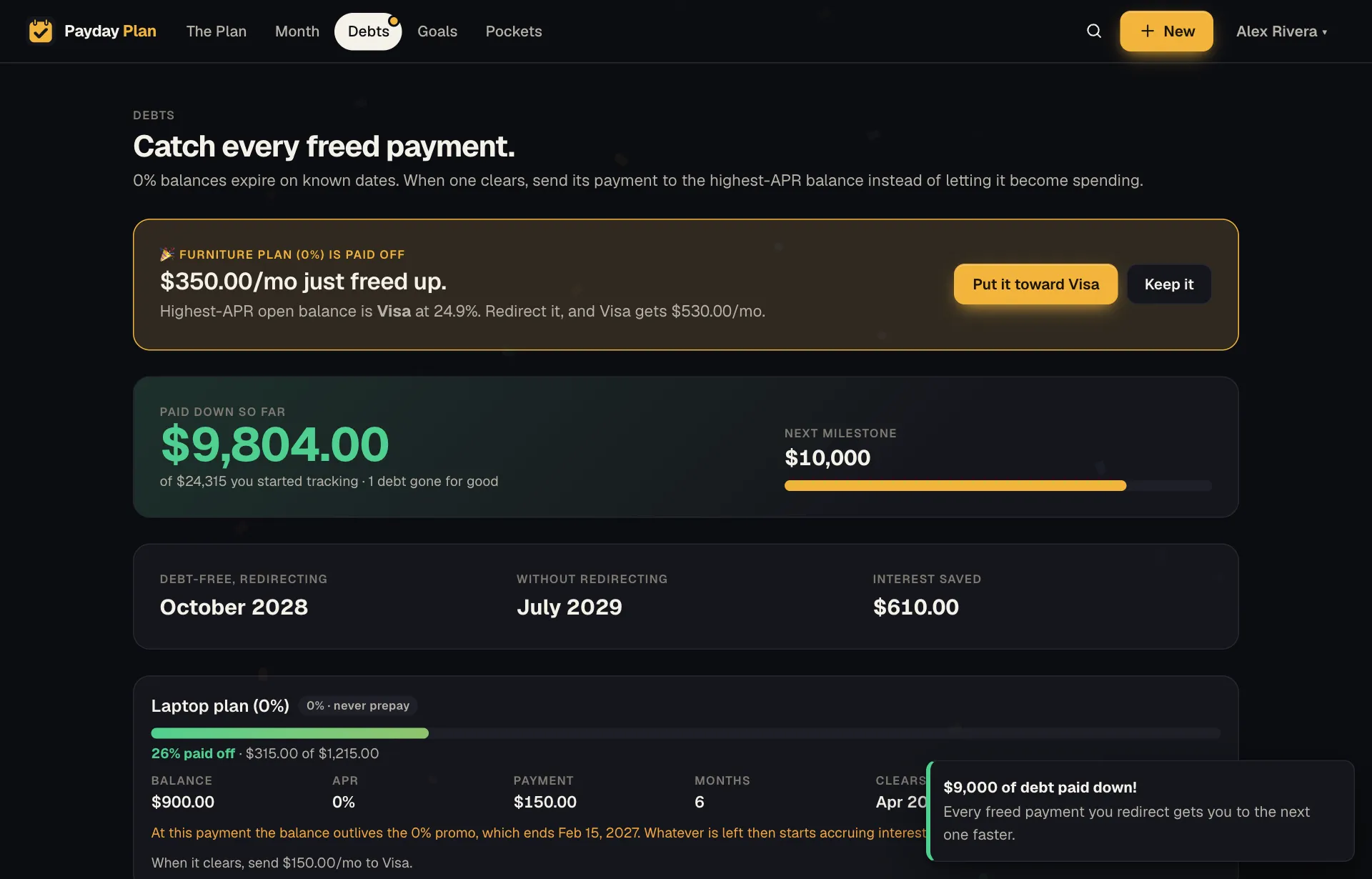
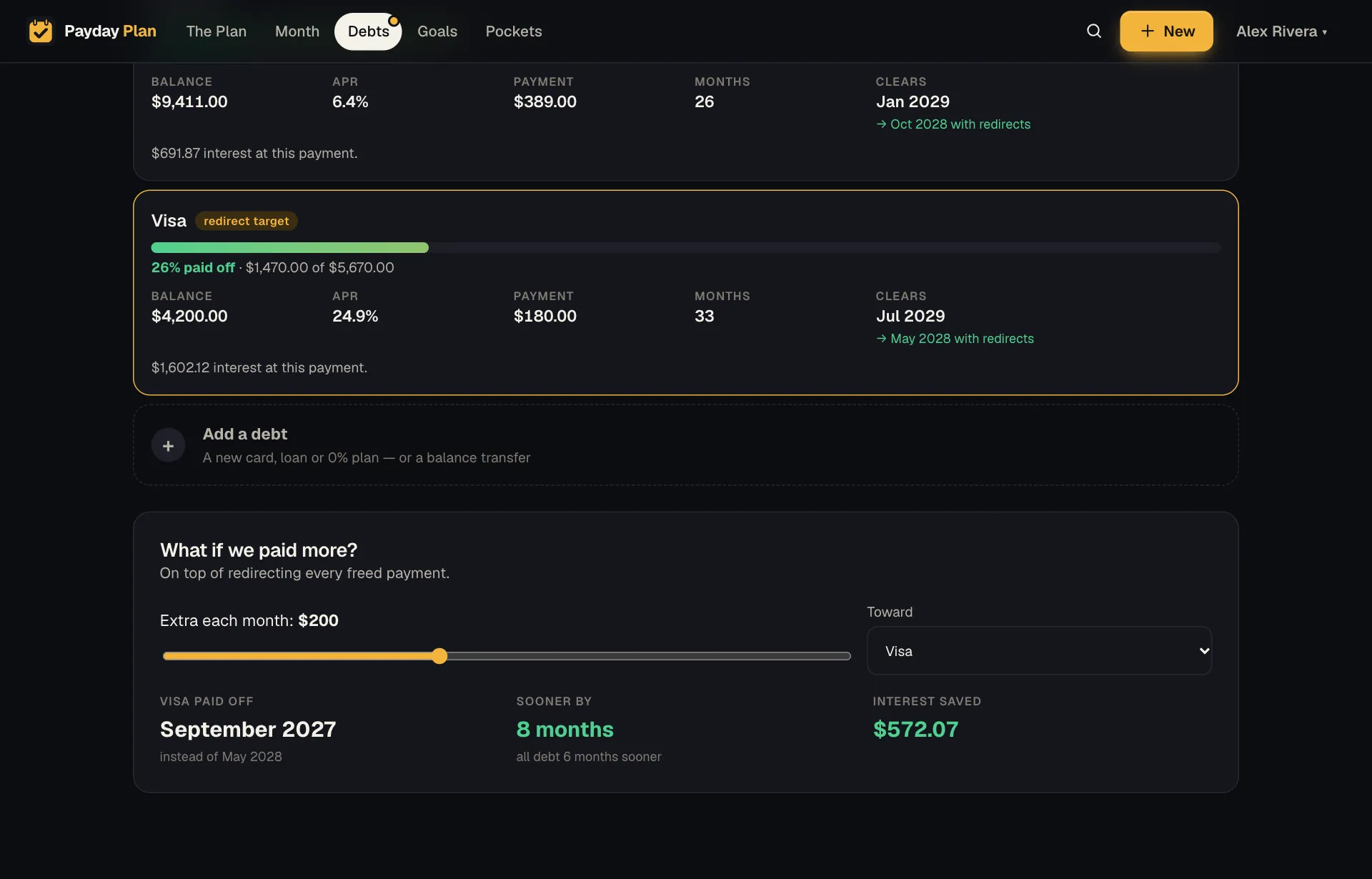
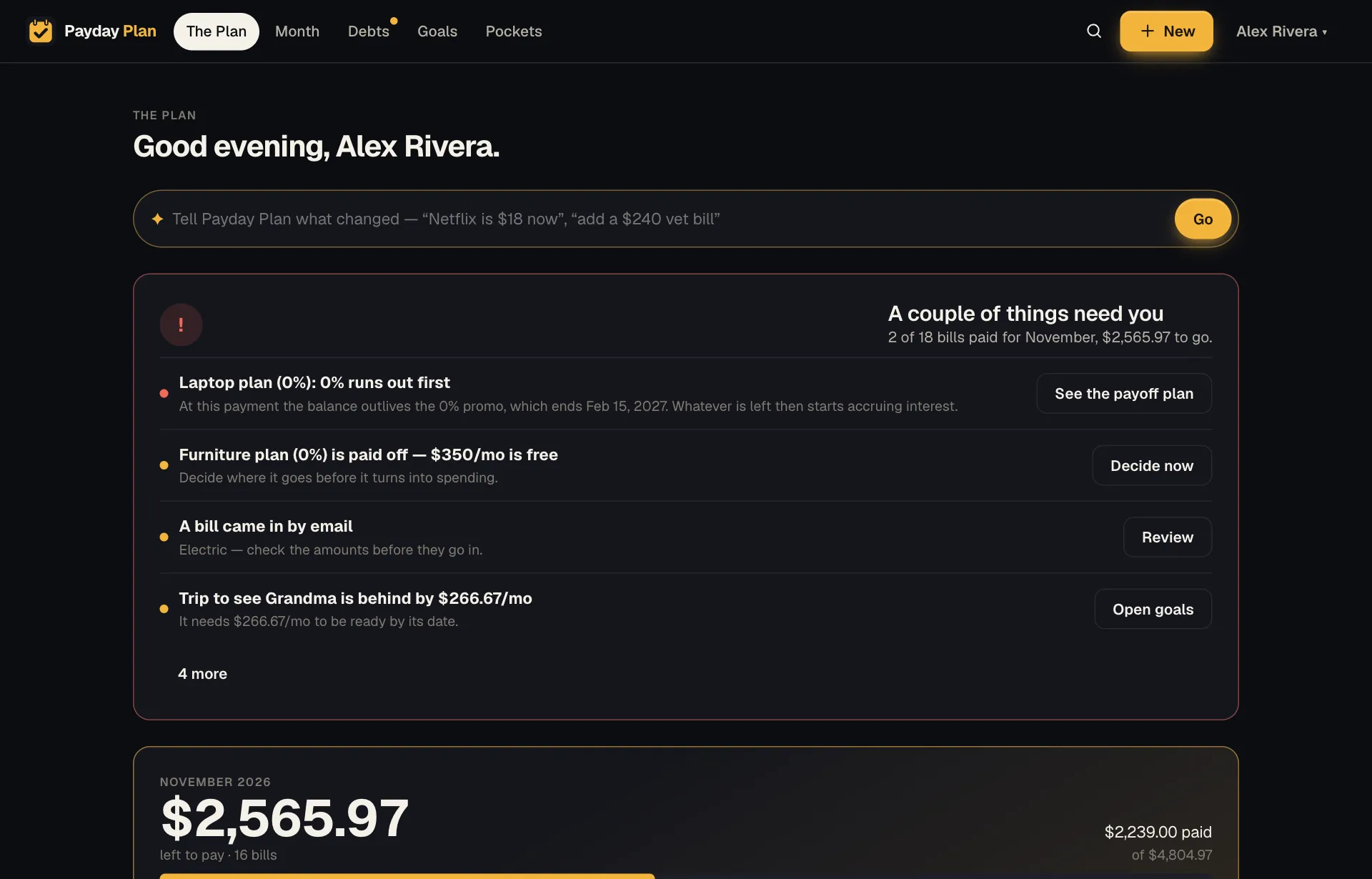
Try it: In Payday Plan, 0% debts are never offered as a redirect target when another debt is paid off, and the freed payment goes to the highest-APR open debt instead. For a promotion with an end date, set its APR to 0 and add the date. The runway warns you if the balance will outlive the promotion, and both adults get an email 60, 30 and 7 days before it reverts.
You can add one in a sentence:
Sofa plan $1,400 at 0%, $100 a month on the 9th