The last car payment goes out. There's a small celebration. The next month, the $420 that used to leave on the 6th just stays in the account.
Three months later, nobody can say where it went. Nothing bad happened. There was a slightly nicer grocery shop, a couple more takeaways, a pair of shoes that weren't strictly needed. The money got absorbed, the way money always does when it doesn't have a job.
That's the most expensive moment in paying off debt, and it's easy to miss because it feels like winning. Here's the rule that covers it:
Every freed payment gets a decision, in the month it's freed.
Not a particular decision. A decision.
Why the timing matters so much
The month a payment ends is the only month that money is invisible to your lifestyle. You've been living without it for years. Your spending is already shaped around it not being there. Redirecting it costs you nothing you'll feel.
Wait three months and it's a different story. By then the money has been spent, the new habits are in place, and redirecting it feels like a pay cut. Same $420. Very different decision.
So the window is short and it's right now.
The three good answers
There are really only three sensible things to do with a freed payment.
1. Send it to your highest-interest debt
If you have other debts that charge interest, this is usually the strongest move. Add the freed amount to the payment on whichever debt has the highest APR. Not the smallest balance, not the one that annoys you most: the highest rate. Each dollar there saves the most interest.
2. Send it to a goal
If you don't have interest-bearing debt left, or if you have no emergency fund at all, a savings goal can be the better home. The emergency fund, a sinking fund for something you know is coming, a trip you'd otherwise put on a card.
3. Keep it, on purpose
This is allowed. Sometimes the household budget has been too tight for too long, and loosening it is the right call. The difference between this and drift is that you chose it, you know the amount, and you know where it goes. "We're adding $200 to groceries and $220 to the trip fund" is a decision. "It'll just be in there" isn't.
What you should not do with it
Don't prepay a 0% plan. If you've got a furniture or phone plan at 0% interest, paying it off early saves you exactly nothing. That money is more useful on a debt that charges interest, or sitting in savings where it earns some. (The one caution: if the 0% ends on a date and the balance won't be gone by then, that's a separate problem worth planning for.)
A worked example
A made-up household has just made the last $420 payment on a car loan. They still have:
| Debt | Balance | APR | Monthly payment |
|---|---|---|---|
| Card A | $4,800 | 24.99% | $150 |
| Card B | $2,300 | 19.99% | $90 |
| Sofa plan | $1,200 | 0% | $100 |
The highest APR is Card A. Its monthly interest right now is about $4,800 × 24.99% ÷ 12 ≈ $100. Most of the $150 payment is just keeping up.
Here's what happens to Card A under each choice, assuming no new spending on it and the rate stays put:
| Monthly payment | Paid off in | Total interest | |
|---|---|---|---|
| Keep paying $150 | $150 | about 54 months | about $3,190 |
| Add the freed $420 | $570 | about 10 months | about $534 |
That's roughly $2,650 less interest, and more than three and a half years sooner. And when Card A is gone, its whole $570 becomes the next freed payment, and the same rule sends it to Card B.
Notice what they didn't do. They didn't throw the $420 at the sofa plan just because it's the smallest balance and would be gone fastest. That would have cleared it in three months and saved exactly zero dollars of interest.
Make it a household rule, not a mood
The freed-payment decision is easy to make in principle and easy to forget in practice. Some ways to make it stick:
- Know your payoff months in advance. If you know the car loan ends in March, you can agree in January what happens to it.
- Decide together. If two of you share the money, the freed payment is a joint decision. It's often the biggest chunk of new money either of you will see all year.
- Change the automation the same week. Raise the payment on the target debt, or change the automatic transfer to savings. Good intentions don't move money; standing instructions do.
- Write down the order. Once you've listed your debts by APR, the next target is never a fresh debate.
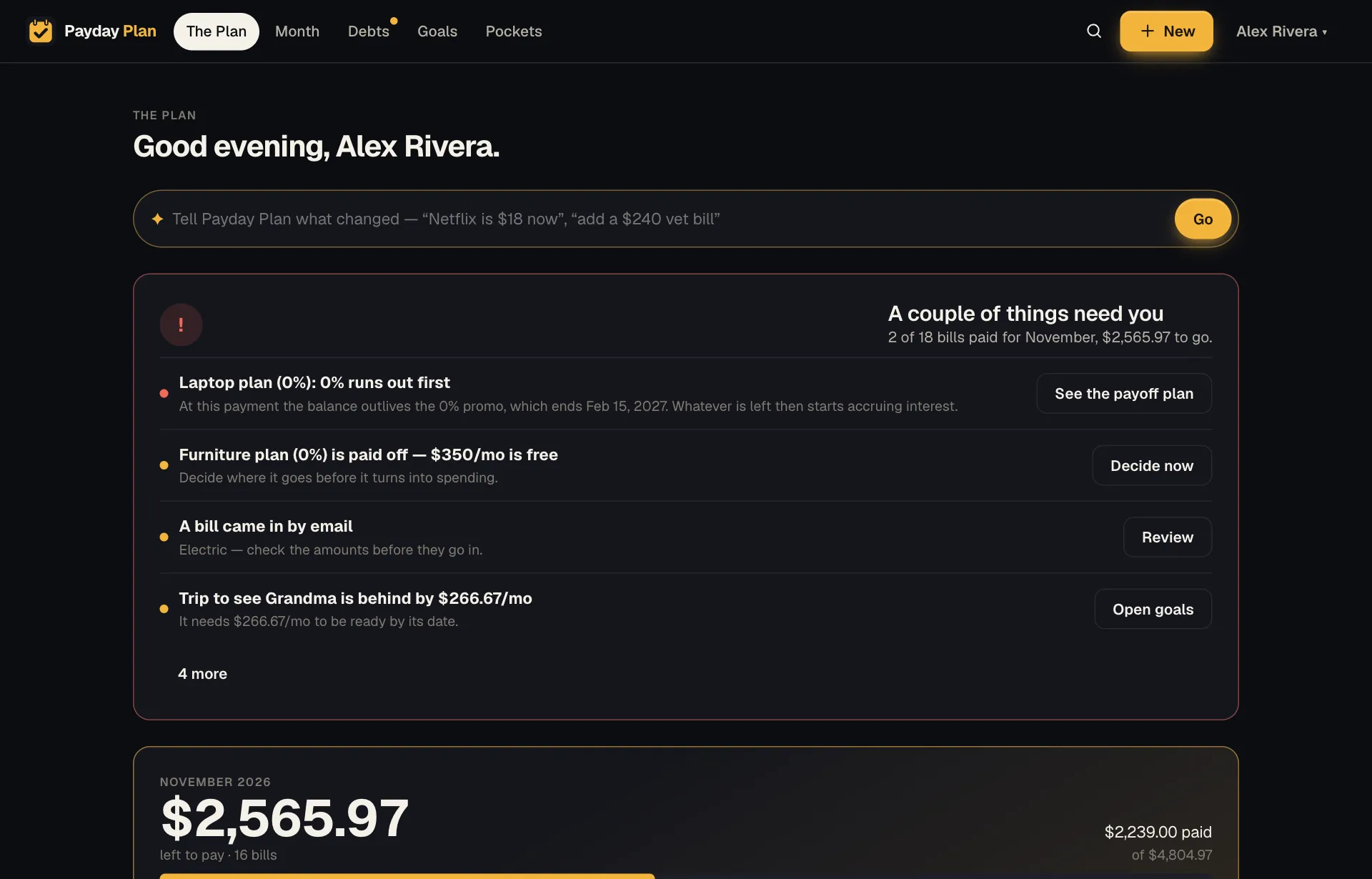
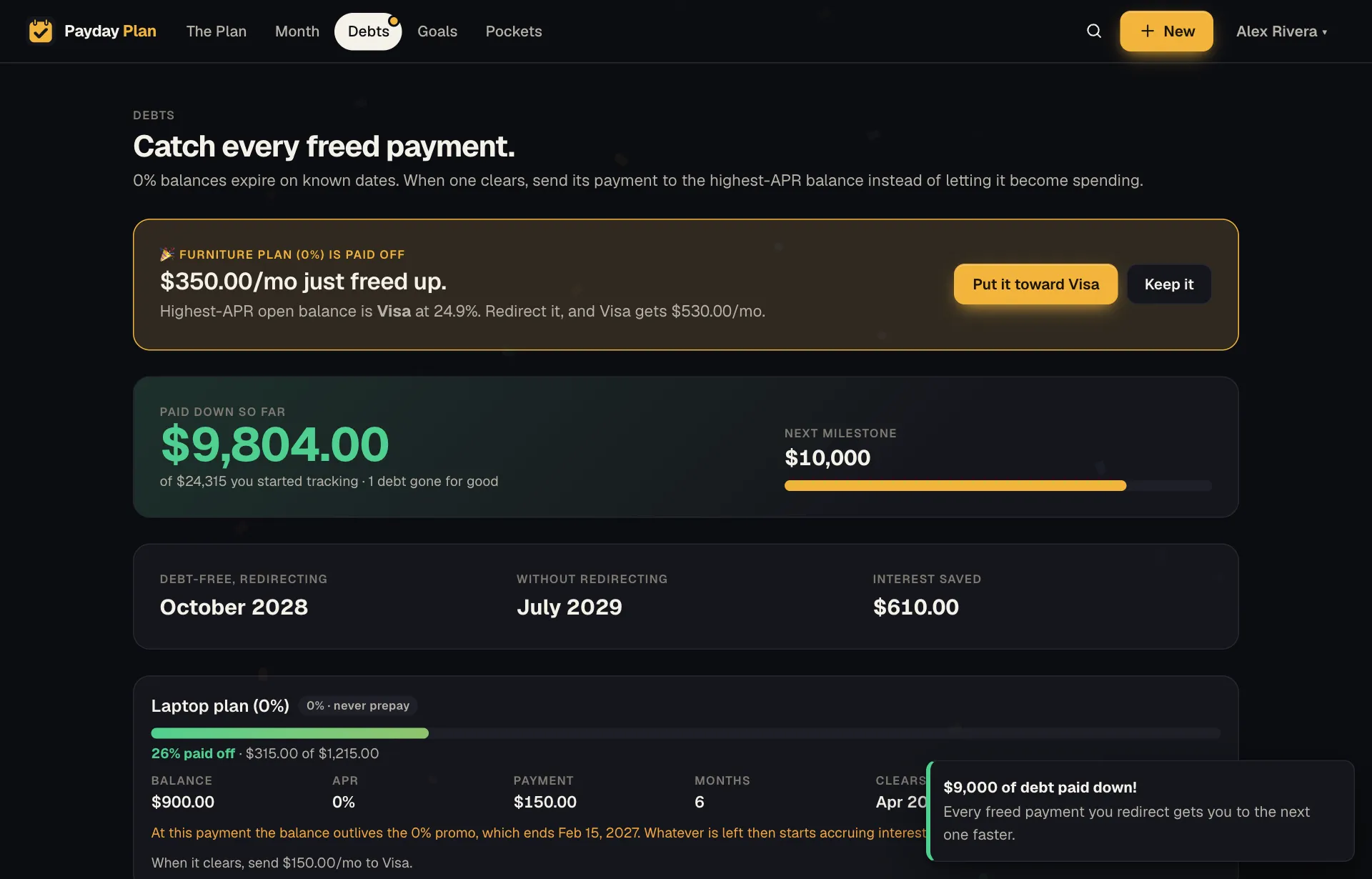
Try it: When a debt in Payday Plan reaches zero, its bill stops recurring and a prompt appears for both adults: redirect the freed payment to the highest-APR open debt (one click raises that debt's payment and its bill), or keep it. 0% debts are never offered as targets. Once every interest-bearing debt is gone, a freed payment goes to the goal that's furthest behind.
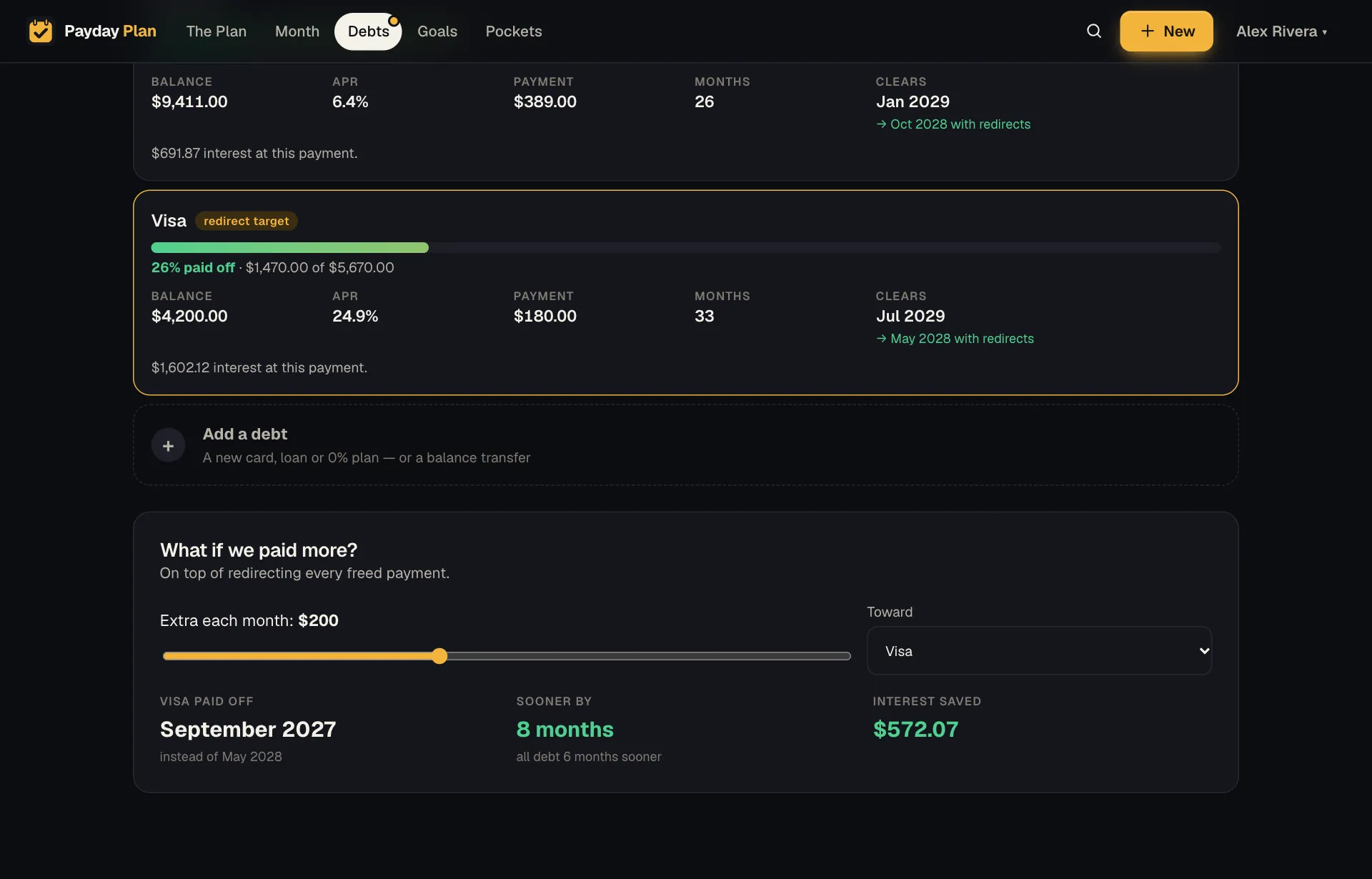
The Debts page also has a what-if slider, so you can see the payoff month move before you commit.