"Keep three to six months in an emergency fund" is one of the most repeated pieces of money advice there is. It's reasonable advice. It also skips the question you need answered before you can act on it: three months of what?
Three months of take-home pay? Three months of what you currently spend? Three months of what you'd need if things went wrong? For a typical household those can be thousands of dollars apart. Pick the wrong one and the target is either so big it's demoralising or so small it won't do its job.
What the fund is for
Start with the job. An emergency fund pays for the life you need to keep running when the normal money stops or a big unplanned cost lands. A job loss. Illness. The car dying. A boiler in January.
That framing already rules out one candidate. You don't need to replace your income, because not all of your income is spent on things you'd keep paying in an emergency. You need to replace the outgoings that would carry on.
Three ways to count a month
Months of income. The biggest number, and the least useful. It includes the money you currently save, invest or send to extra debt payments, none of which you'd need to keep doing in a crisis.
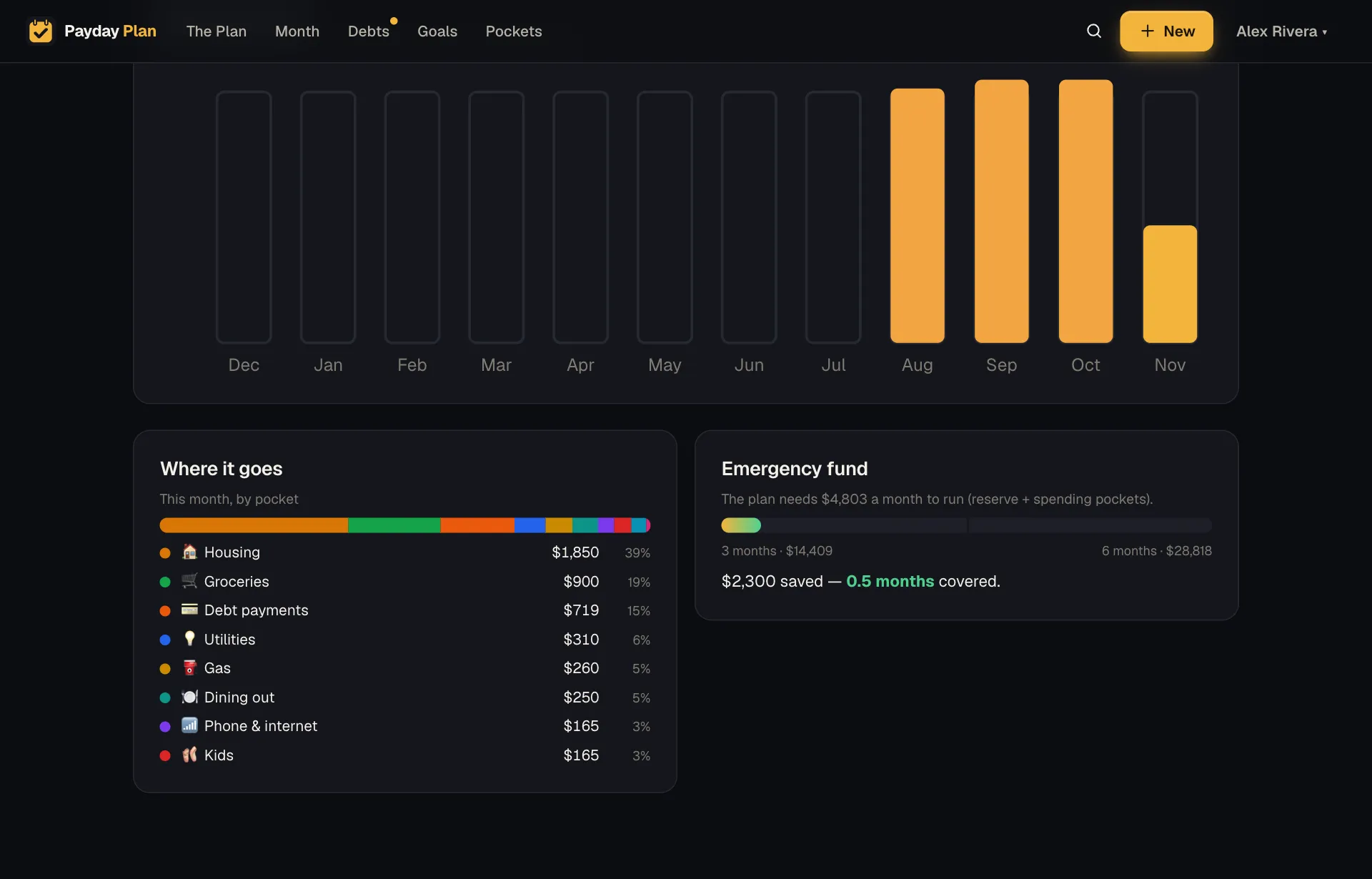
Months of your plan. Everything your budget sends out in a normal month: bills, debt payments, everyday spending. It's a solid, honest target, easy to calculate if you have a plan, and it doesn't ask you to imagine which things you'd cut.
Months of essentials. Only what you'd keep paying in a tough stretch. Housing, utilities, insurance, minimum debt payments, food, transport, childcare if it would continue. This is the floor: the least that would actually see you through.
A worked example
A made-up household. They take home about $6,500 a month on average. Their monthly plan is $5,685: $4,285 of bills and $1,400 for groceries, gas and everyday spending.
If the income stopped, they'd keep paying rent, the car, utilities, phone, internet, insurance and the minimum on their card. Childcare stays, because both of them would be job-hunting. Streaming goes. Everyday spending drops from $1,400 to about $1,000.
| Count | Per month | 3 months | 6 months |
|---|---|---|---|
| Income | $6,500 | $19,500 | $39,000 |
| The plan | $5,685 | $17,055 | $34,110 |
| Essentials | $5,240 | $15,720 | $31,440 |
From smallest to largest, the targets range from about $15,700 to $39,000. That's the gap "three to six months" leaves open.
For most households, months of the plan is a good working target and months of essentials is a sensible floor. Income is rarely the right measure.
Three months or six?
The second half of the advice depends on how likely and how long a disruption could be. Things that usually push toward the higher end:
- One income, or one income the household relies on heavily.
- Irregular income: self-employment, commission, seasonal work.
- A job that would take a long time to replace, because it's specialised or local options are thin.
- Dependants, or health conditions that make costs less predictable.
- Owning a home or an older car, where large repairs are the owner's problem.
And toward the lower end: two stable incomes from different employers, a job in strong demand, a landlord who handles repairs.
There's no correct number, only one that fits your risks. If you're unsure, pick the middle and revisit it once a year.
Note: This is general education, not personal financial advice. If you have specific circumstances such as health, self-employment or large debts, it can be worth talking to a qualified adviser.
When you also have expensive debt
This is the honest tension. Every dollar in an emergency fund could be paying down a card at 24%. Every dollar paid to the card is a dollar you can't reach if the car breaks down, and that often ends with the repair going straight back on the card.
A common approach is to do it in stages:
- A starter fund first, enough for a typical surprise. Many people use something like one month of essentials.
- Then attack the expensive debt, highest APR first, rolling each freed payment onto the next.
- Then build the full fund once the high-interest debt is gone, using the payments that debt used to need.
The starter fund is what stops the debt plan from being undone by a flat tyre.
What doesn't belong in it
The emergency fund is for what you can't predict. Things you can predict, like registration, tuition, the trip, a deductible you know you'll meet, belong in sinking funds. When those get paid from the emergency fund, it shrinks without an emergency having happened, and you find out how low it is at the worst moment.
Keep it somewhere separate from everyday money, easy to reach in a day or two, and ideally earning some interest. Separate enough that you don't dip into it for a sale; reachable enough that you can use it on a Sunday when you need to.
Building it without noticing
A $15,000 target can feel unreachable. A few things make it less so:
- Automate it, a fixed amount each payday.
- Give it the third paycheck in months that have one, if you're paid biweekly.
- Give it a freed payment when a debt ends and the expensive debt is already gone.
- Mark milestones: the starter fund, one month of the plan, three months. Each one changes what a bad week can do to you.
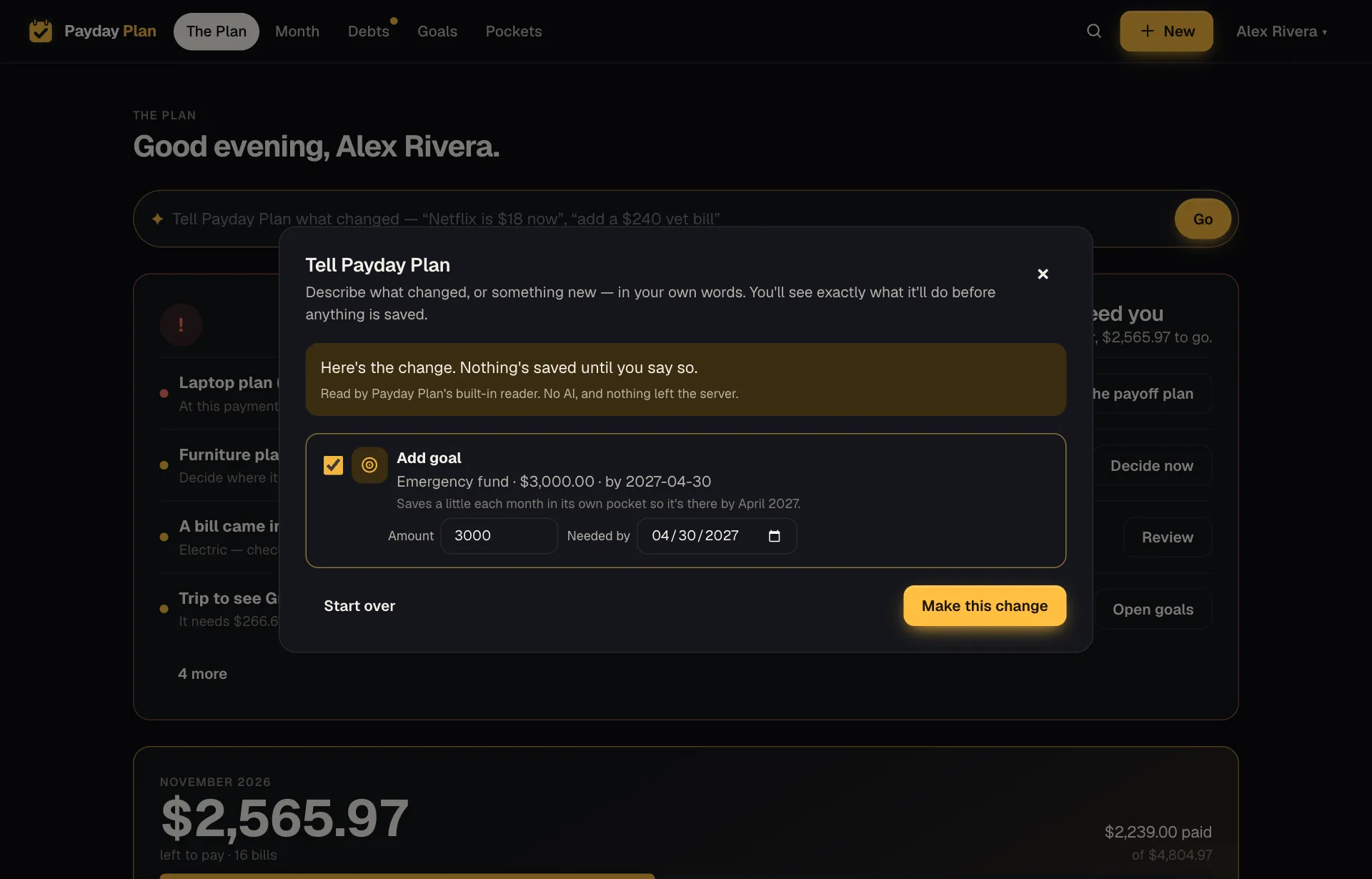
Try it: Payday Plan's Insights page shows an emergency-fund target at 3 and 6 months of your plan, against what the fund holds today. Once every interest-bearing debt is paid off, freed payments go to whichever goal is furthest behind, so a fund set up as a goal gets its share.