Most budgets are good at monthly bills. Rent, phone, internet: they show up every month, at the same amount, and you plan for them without thinking.
It's everything else that does the damage. The car registration in March. The semester's tuition in January. The insurance premium that comes twice a year. A family trip you've been talking about since spring. None of these are surprises. You knew they were coming. They still land on one paycheck and blow a hole in it, and the hole goes on a card.
A sinking fund is the boring, reliable answer. You take a cost that comes once, work out how many months you have, and save a slice each month so the money is sitting there when the bill arrives.
The formula
(Amount needed − already saved) ÷ months left = monthly saving.
Count the current month as one of the months left, as long as you'll save something this month. If it's September and the bill is due in March, that's seven months: September, October, November, December, January, February, March.
Then do the thing that actually matters: set it up as an automatic transfer on payday, into a separate pocket or account. A sinking fund that depends on remembering is a sinking fund that's half full when you need it.
A worked example
A made-up household. It's September. They have three things coming:
| Goal | Due | Cost | Saved so far | Months left | Monthly |
|---|---|---|---|---|---|
| Spring semester tuition | January | $3,200 | $1,500 | 5 | $340.00 |
| Car registration | March | $380 | $0 | 7 | $54.29 |
| Family trip | next July | $2,400 | $200 | 11 | $200.00 |
| Total | $594.29 |
So about $595 a month, or roughly $297 per paycheck if they're paid twice a month.
That might look like a lot. Compare it with the alternative: in January, $1,700 more of tuition than they've saved. In March, $380 in one go. In July, a trip that either doesn't happen or goes on a card. The sinking funds don't make anything cheaper. They make it predictable.
Starting late costs more per month
The same $380 registration, depending on when you start:
| Start saving in | Months left | Monthly |
|---|---|---|
| September | 7 | $54.29 |
| December | 4 | $95.00 |
| February | 2 | $190.00 |
Same bill. The only difference is how much warning you gave yourself. This is the case for writing down every irregular cost you can think of once a year, even if you don't fund them all straight away. You can't save ahead for something you haven't noticed yet.
What deserves a sinking fund
Anything that's certain but not monthly. A quick list to jog the memory:
- Car: registration, insurance if paid yearly, tires, servicing.
- Home: insurance, property tax if not escrowed, a yearly service on the boiler or AC.
- Kids: tuition, school fees, camps, sports seasons, new shoes every few months.
- Calendar: holidays and birthdays, which happen on the same dates every year and still somehow catch people out.
- Subscriptions: anything billed annually.
- Health: dental work you know is coming, glasses, a deductible.
- Fun: the trip, the concert, the new laptop when the old one is clearly dying.
What doesn't: genuine emergencies. A sinking fund is for costs you can name and date. The emergency fund is for the ones you can't. Keep them separate, or the trip money quietly becomes the car-repair money and you find out in July.
Bill or goal?
Some irregular costs are bills with a different rhythm. If the water bill comes every other month, or insurance every six, you can plan it as a bill on that schedule and let the paychecks in those months carry it.
Others are better as goals. If the amount is large, or a single paycheck can't absorb it, save ahead instead. Tuition is the clearest case: no paycheck should have to swallow a semester.
A rough test: if the cost would make one paycheck go negative, it's a goal.
One pocket or many?
Either works. Separate pockets make it obvious how each goal is doing. One "irregular costs" pocket is simpler to run, as long as you know which goal comes first. If you share one pocket, hand the money to the goals in order of due date: the soonest one gets fully funded first.
When the goal repeats
Tuition comes every semester. Registration every year. When one is paid, the goal doesn't end. It resets, and the next one starts counting down.
That's worth noticing, because the steady-state number is often different from the catch-up number. In the example, the household is catching up on January's tuition. Once they're through it, the next semester needs $3,200 over the following months. Two semesters a year is $6,400, which works out at about $533 a month to stay ahead for good. Knowing that number early saves a nasty surprise in February.
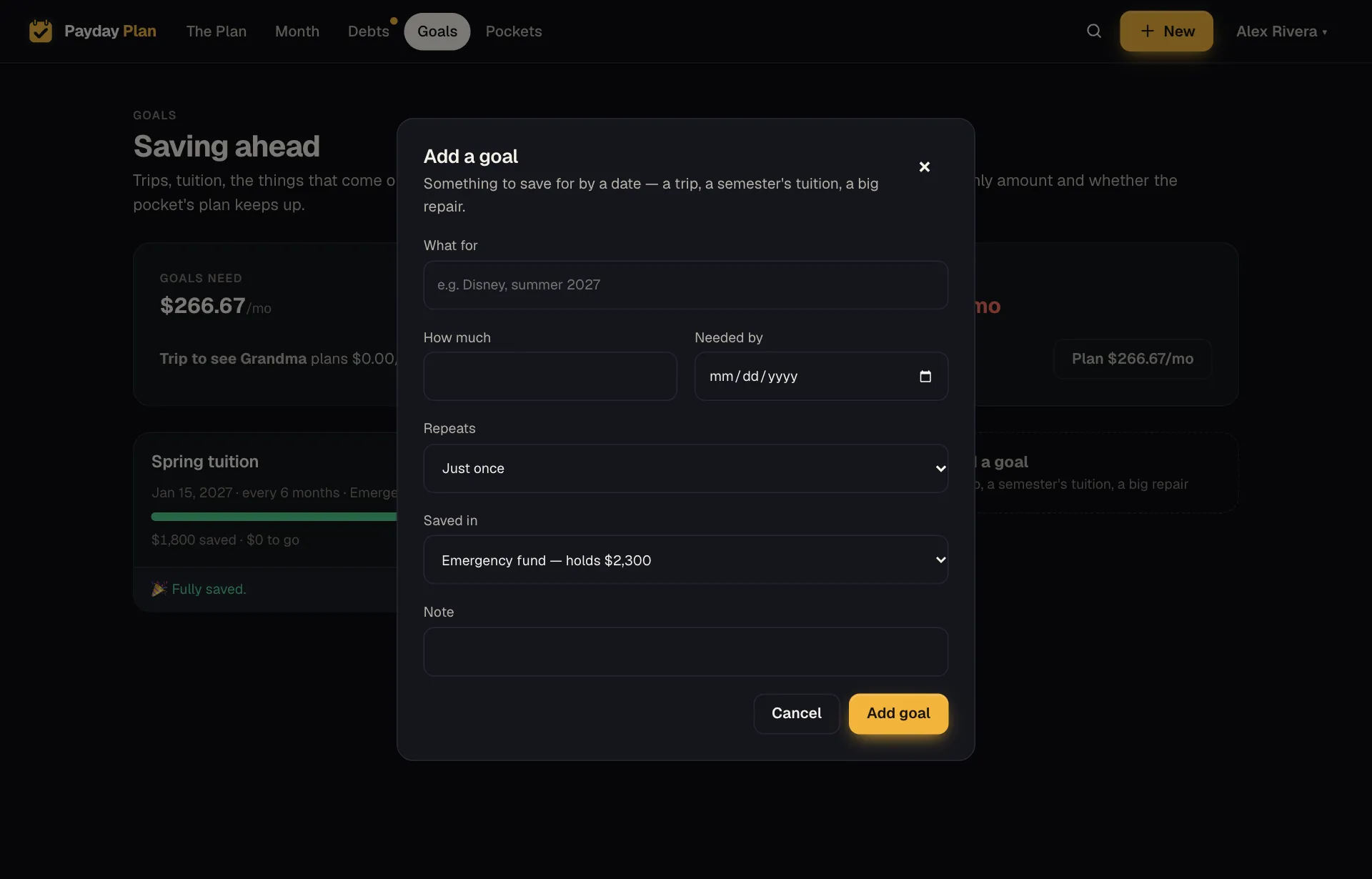
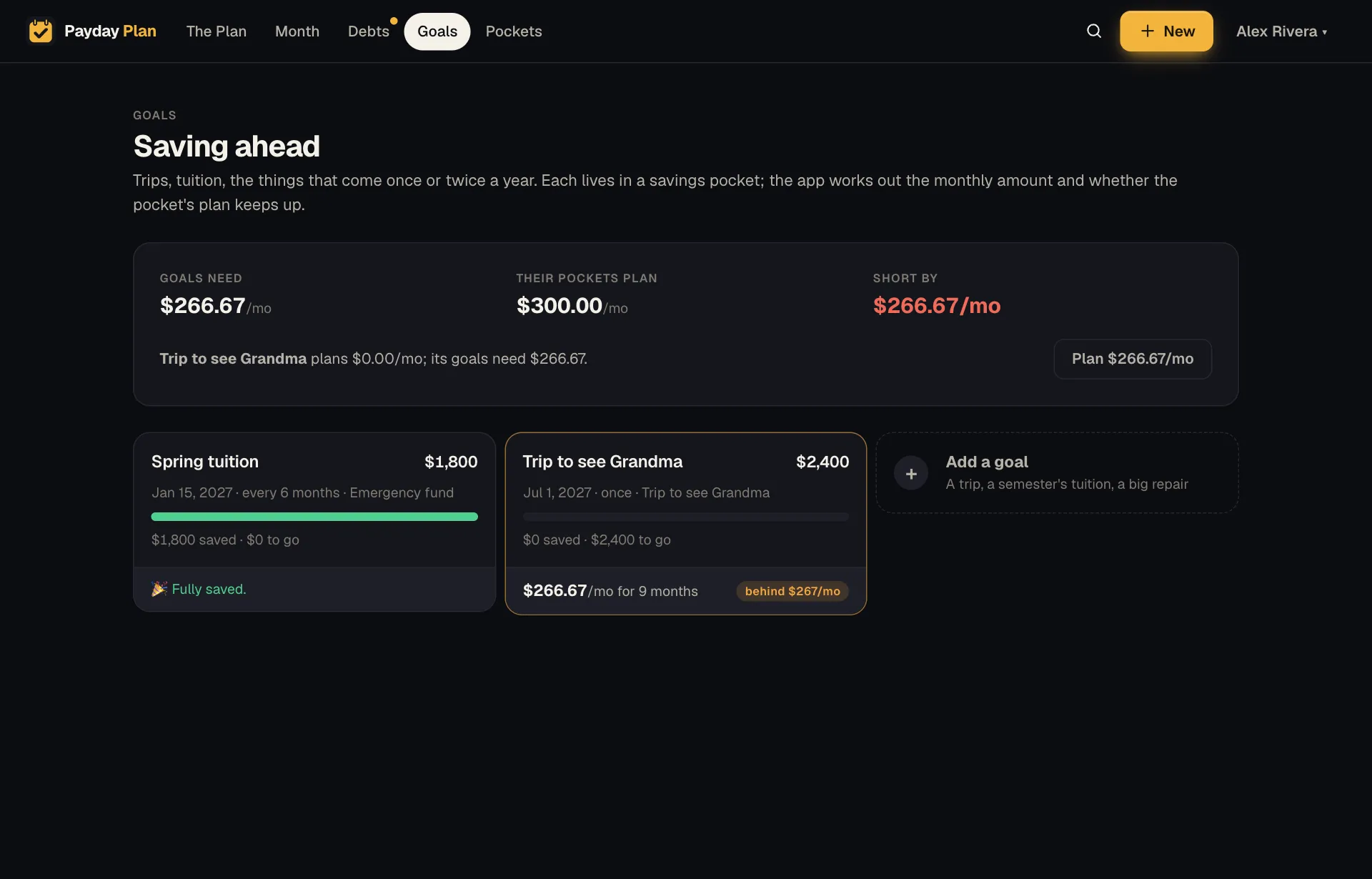
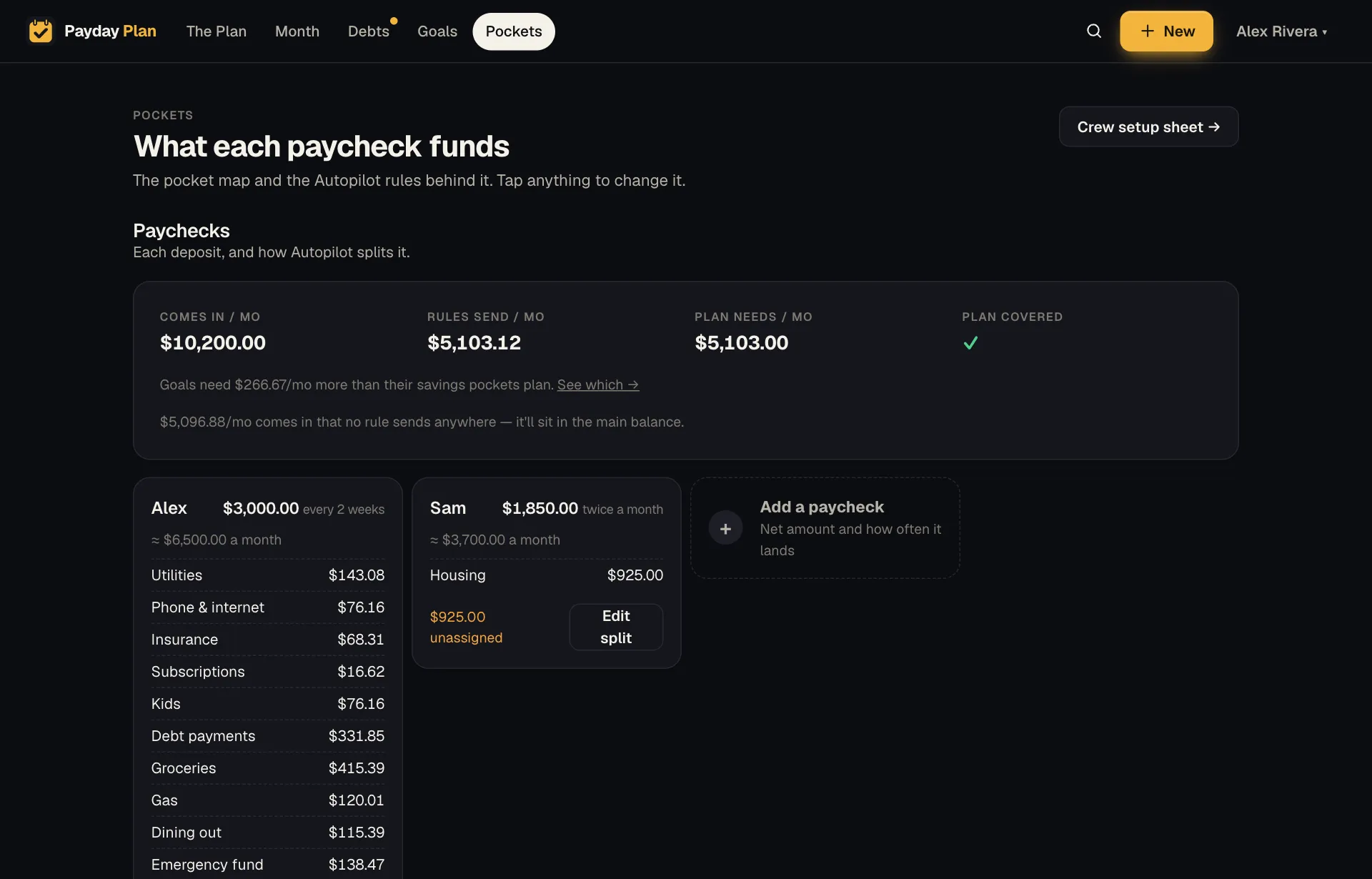
Try it: Payday Plan's Goals page is built for this. Each goal lives in a savings pocket, either once or repeating. The app works out what it needs each month, tells you whether the pocket's plan keeps up (one click raises it if not), and rolls repeating goals forward when one is paid. A pocket's money goes to its goals soonest-due first.
Bills that come every 2, 3, 4, 6 or 12 months can be set up on that schedule, and one-off months can be skipped.
Car registration $380 every March