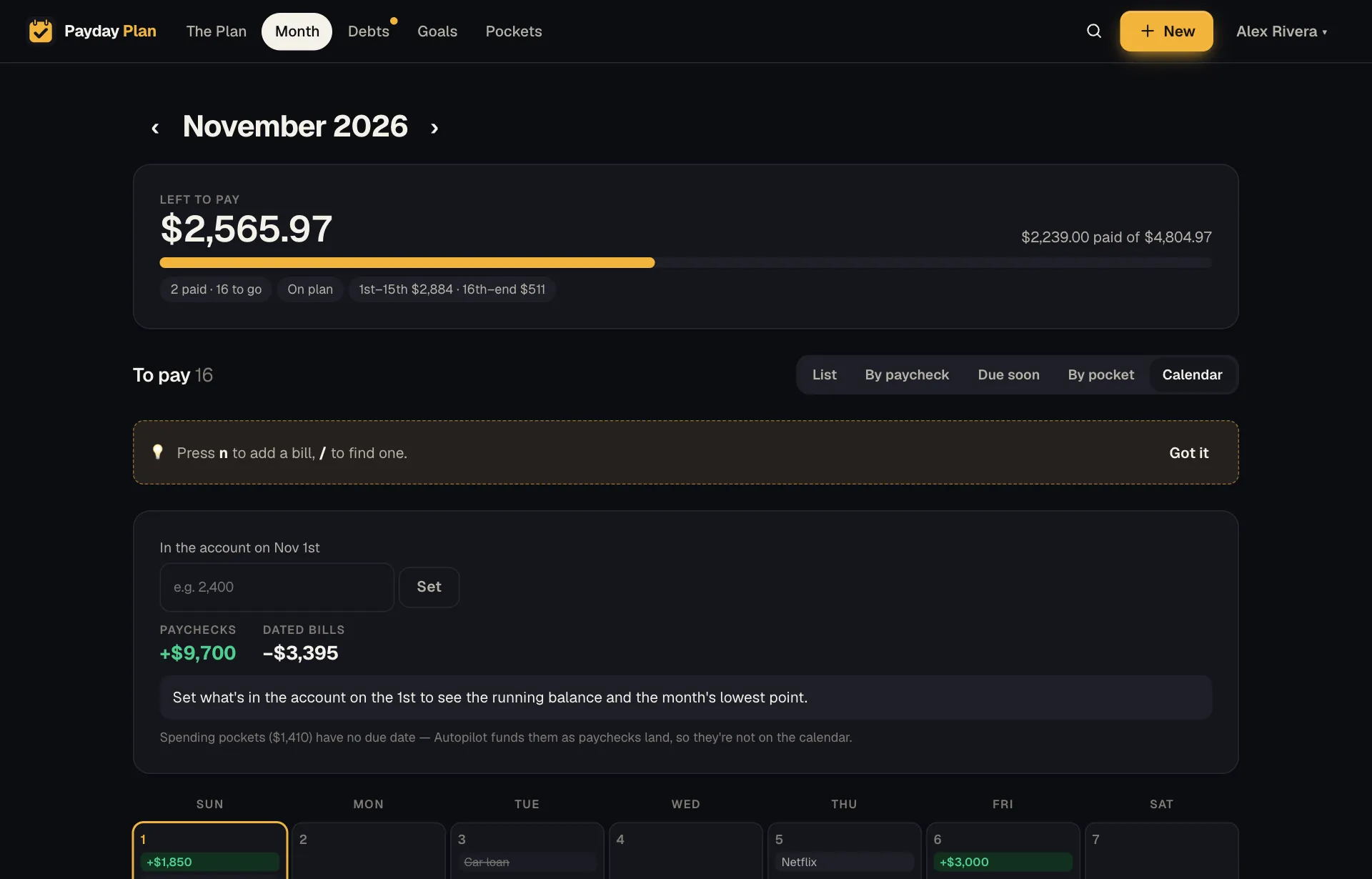
If you're paid every other week, you're not paid twice a month. You're paid 26 times a year. Twelve months of two paychecks is 24, so two of those months bring a third one.
Most households notice this the way you notice a twenty in a winter coat: pleasantly, briefly, and without a plan. The third paycheck lands, the account looks roomy for a week, and by the end of the month it's gone into the general fog of things.
That's a shame. A third paycheck is about the cleanest money a household ever gets. Your bills were already covered by the other two. Nothing is waiting for it. You can decide exactly where it goes, months ahead of time.
Find your three-paycheck months
You can work it out from one date: your next payday.
Count forward fourteen days at a time and watch for a month that holds three of them. A month needs at least 29 days for that to happen, and the third payday has to land late in the month. For example, if your first payday of 2027 is Friday, January 8, the paydays run:
| Month | Paydays |
|---|---|
| January | 8, 22 |
| February | 5, 19 |
| March | 5, 19 |
| April | 2, 16, 30 |
| May–September | two each |
| October | 1, 15, 29 |
| November | 12, 26 |
| December | 10, 24 |
April and October are your extra-paycheck months. That's 26 paydays in all.
Shift the start by a single week and it all changes. If your first payday of 2027 were Friday, January 1, you'd get 27 paydays that year, with three-paycheck months in January, July and December. That happens every eleven years or so. It's worth knowing in advance: some employers spread an annual salary across 27 paychecks that year, so each one comes in a little smaller.
Note: "Twice a month" pay (the 1st and 15th, say) is a different schedule: 24 paychecks a year and no extras. This guide is about every-other-week pay.
Why the first two paychecks should carry the month
The whole trick depends on one habit: plan every month as if it has two paychecks.
If your plan quietly leans on a third paycheck, say by spreading bills across "every paycheck", then the months with two paychecks come up short. You end up borrowing from the good months to cover the normal ones, and the extra money never feels extra.
So line your bills up against the first two paydays of each month and make them fit. Then the third paycheck, when it comes, has no bills attached. It's genuinely spare.
A worked example
A made-up household: one income of $3,000 every other Friday, after tax. Their monthly plan comes to $5,400. That's rent, utilities, the car, a card payment, groceries and gas, and a little left over.
In an ordinary month:
| Amount | |
|---|---|
| Two paychecks | $6,000 |
| The month's plan | $5,400 |
| Left over | $600 |
In April 2027, the plan is still $5,400, because rent doesn't triple. But a third $3,000 arrives on the 30th.
Over a year, that's $6,000 of extra paychecks, against a plan that was already balanced without them. Ten percent of a year's take-home, arriving on dates you know a year ahead. That's not a windfall. It's a line item you get to schedule.
Four good jobs for a third paycheck
There's no single right answer, but there are good ones. Pick before the money lands, not after.
1. Top up the emergency fund. If yours is thin, this is the obvious first job. Two extra paychecks a year can build a real cushion without cutting anything.
2. Pay down your highest-interest debt. On a card at 24%, interest runs about $60 a month for every $3,000 owed, since $3,000 × 0.24 ÷ 12 = $60. Knocking $3,000 off that balance saves you that $60 every month it would otherwise have stayed. Don't send it to a 0% plan, though. Paying off interest-free money early saves nothing.
3. Fund the irregular bills. Car registration, the six-month insurance premium, holiday gifts, school fees. If you don't already save for these a little each month, a third paycheck can pre-fund a big chunk of the year.
4. Spend some of it, on purpose. A planned weekend away paid in cash beats a vague month of "we had a bit extra". Half to a goal, half to something fun is a perfectly sensible split.
The one bad job is no job. Undecided money spends itself.