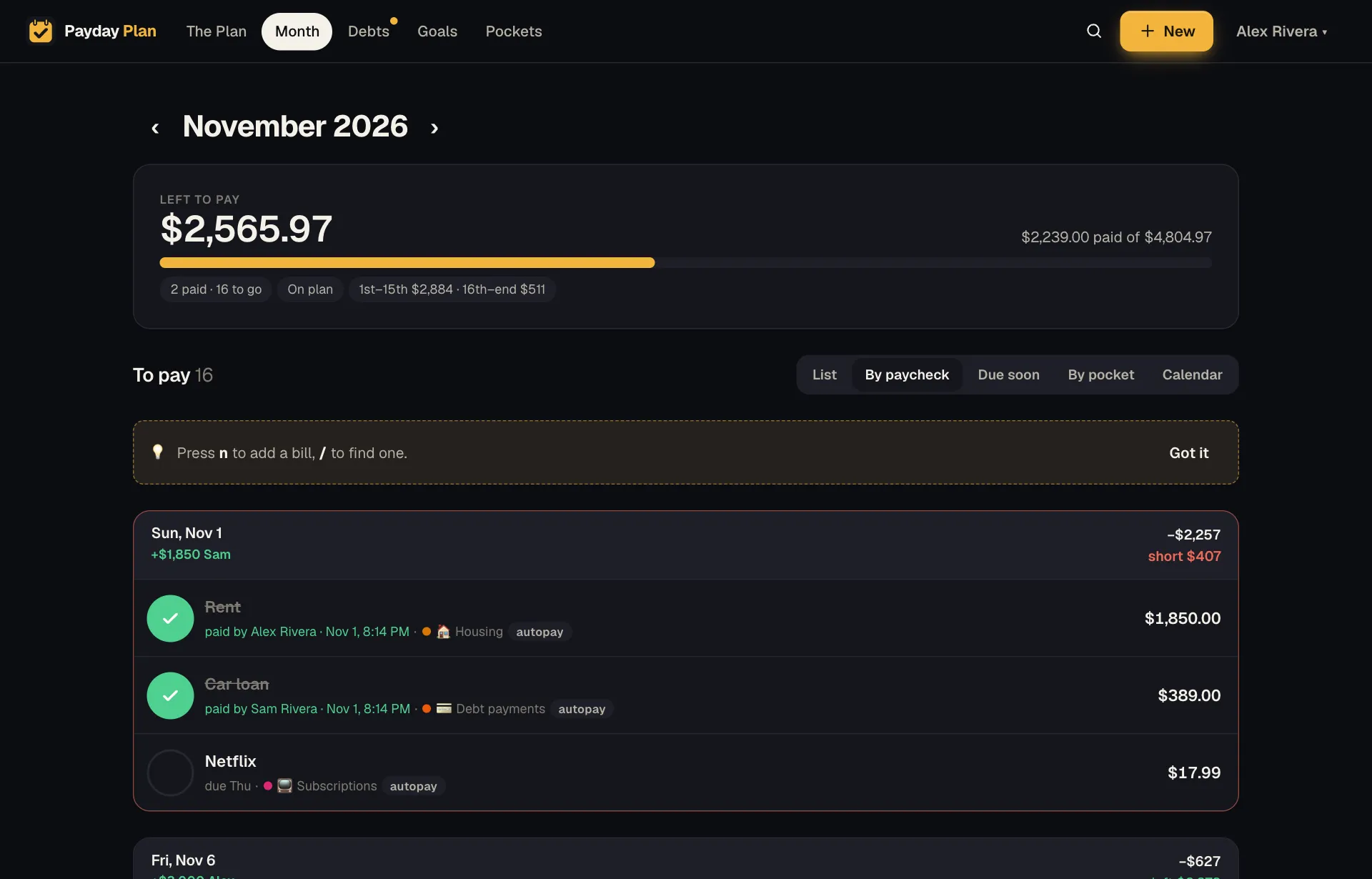
Most budgets start with a month. Income at the top, bills underneath, a number at the bottom that says you're fine. Then the 24th arrives, the account is down to fumes, and nobody can work out where it went, because on paper the month balanced.
It did balance. The problem is that money doesn't arrive as a month. It arrives as paychecks, on particular days, and bills leave on particular days too. A plan that only adds things up over thirty days can't see that the rent comes out four days before the money that's supposed to pay it.
So plan the way the money actually moves: one paycheck at a time.
The one rule
Every bill belongs to the paycheck that will be sitting in the account when it's due. That's the most recent payday on or before the bill's due date.
That's it. A paycheck on the 3rd covers everything due from the 3rd up to the day before the next payday. The next paycheck covers the stretch after that. Each paycheck gets its own small budget: what came in, which bills it has to cover, what it needs to hand to groceries and gas, and what's left.
Bills due before the month's first payday get paid from whatever is already in the account, which in practice means whatever the last paycheck of the previous month left behind. That's where most budgets quietly break.
A worked example
Here's a made-up household. One take-home paycheck of $3,000, every other Friday. This month the Fridays fall on the 3rd and the 17th. Their bills:
| Bill | Due | Amount |
|---|---|---|
| Rent | 1st | $1,900 |
| Car payment | 6th | $420 |
| Electric | 9th | $140 |
| Phone | 12th | $120 |
| Car insurance | 15th | $180 |
| Internet | 18th | $80 |
| Credit card payment | 21st | $300 |
| Childcare | 26th | $1,100 |
| Streaming | 28th | $45 |
| Total | $4,285 |
On top of that they plan $1,400 a month for groceries, gas and everyday spending, so $700 per paycheck.
By calendar, this works. Two paychecks bring in $6,000. Bills and spending come to $5,685. There's $315 to spare.
Now split it by paycheck. The 17th's paycheck has to last until the next payday, which in a 31-day month is the 31st, and in the following month the rent is due on the 1st. So the second paycheck is on the hook for next month's rent as well as everything from the 17th onward.
| Paycheck on the 3rd | Paycheck on the 17th | |
|---|---|---|
| Comes in | $3,000 | $3,000 |
| Bills it covers | $860 (car, electric, phone, insurance) | $3,425 (internet, card, childcare, streaming, next month's rent) |
| Share of spending | $700 | $700 |
| Left over | $1,440 | −$1,125 |
Same month, same $315 surplus overall. But the first paycheck looks flush and the second one is $1,125 short. If they spend the first paycheck's "extra" in the first fortnight, rent bounces, or goes on a card.
The fix is boring and it works: move $1,125 from the first paycheck into a separate reserve pocket for rent the day it arrives. Now both halves of the month are honest. The first paycheck has $315 that's genuinely free, and the second one breaks even.
Note: Biweekly paydays drift. Next month the Fridays might be the 14th and the 28th, and the pairing of bills to paychecks changes. Check the split each month rather than setting it once and trusting it forever.
The third paycheck isn't a raise
If you're paid every other week, you get 26 paychecks a year, not 24. Averaged out that's about 2.17 a month (26 ÷ 12). In our example the honest monthly income is $3,000 × 26 ÷ 12 = $6,500.
That average is a trap if you budget to it. Ten months of the year you get two paychecks, $6,000, and a plan built on $6,500 comes up $500 short in each of them. The money you're "missing" turns up in a lump in the two months that have a third Friday.
Better: build the everyday plan on two paychecks. Then decide in advance what the third one does. Good candidates are a sinking fund for the car registration, a chunk off your highest-interest debt, or a top-up to the emergency fund. What it shouldn't do is disappear into a nice fortnight nobody remembers.
Why this beats a buffer
The usual advice is "keep a cushion in checking." A cushion helps, but it hides the shape of the problem. You end up with a vague sense that money is tight in the back half of the month and a vague amount set aside to cope with it. Planning by paycheck tells you exactly how much the second half needs from the first, and why. That's a number you can automate.
It also changes the question you ask on a Saturday. Not "how much is in the account?" but "how much is this paycheck's to spend?" Those are very different numbers in the week before rent.
Making it stick
- Write down your paydays for the next three months. For biweekly pay, count forward 14 days at a time. Note any month with three.
- Give every bill a due day. "Mid-month" isn't a due day.
- Group the bills by paycheck. Use the rule above.
- Find the short paycheck. There usually is one, and it's usually the one before rent or the mortgage.
- Move the gap on payday. A reserve pocket that receives a fixed amount from the long paycheck is the simplest version. If your bank splits deposits into pockets automatically, set that rule once.