Payday Plan

Guides / Bills

Estimates to actuals: make your plan honest in three months

Every new budget is built on guesses. Here's a simple routine for replacing them with real numbers, so the plan stops being quietly optimistic.

September 28, 20267 min readJump to the steps ↓

Every budget starts as a set of guesses. Electric, about $120. Groceries, $600 should do it. Phone, roughly $100.

That's fine. You have to start somewhere, and a plan built on guesses is far better than no plan. The problem is that guesses tend to be optimistic, and they stay in the plan long after you have the information to fix them. Months later the budget still says groceries are $600, every month comes up a little short, and nobody can say exactly why.

The fix takes about three months and very little effort: record what actually came out, and once you have three real numbers, replace the guess.

Why guesses run low

It isn't carelessness. It's how memory works. You remember the typical bill, not the high ones. You remember the grocery shop, not the extra trip on Thursday for milk and the thing you forgot. You remember last year's price, not this year's.

So most plans aren't wrong by a lot in any one place. They're wrong by a little in many places, mostly in the same direction. That adds up.

The routine

1. Record the actual every time. When a bill goes out, note what it really was, not what you planned. For variable spending like groceries, note the month's total.

2. Leave the plan alone for now. Recording this month's actual is not the same as changing the plan. One high electric bill shouldn't rewrite the budget.

3. After three months, compare. For each item that's been different every month, take the average of the three actuals.

4. Replace the estimate. Put the average in the plan. Done, until something changes.

Three months is a good balance. One month is noise. Twelve months is too long to live with a plan you know is off.

A worked example

A made-up household set up their plan in June. By the end of September, they have three months of real numbers:

Item Estimate Jul Aug Sep Average Monthly gap
Electric $120 $164 $188 $152 $168 +$48
Phone $100 $112 $112 $112 $112 +$12
Groceries $600 $660 $720 $690 $690 +$90
Car insurance $200 $180 $180 $180 $180 −$20
Net +$130

The plan has been $130 a month too optimistic. Over a year, that's $1,560: money the household thought it had and didn't. That's the feeling of "we're doing everything right and still always short," expressed in one number.

Notice the car insurance. Estimates don't only run low. Fixing them sometimes hands money back.

Watch out for seasonal bills

The electric bill in the example covers July to September: air-conditioning months. Replace the estimate with $168 and the plan will be a little high in spring and autumn, then perhaps too low in a cold January.

For bills that swing with the seasons, there are a few reasonable approaches:

  • Use a full year of history if your provider shows it, and plan the twelve-month average.
  • Ask about level billing. Many utilities offer a plan that spreads the yearly cost evenly. Your provider can tell you whether they do.
  • Accept some swing, and check the estimate again each season.

Three months works well for things that are fairly steady. For things that aren't, be a little more patient.

When one month is just weird

A month with a birthday party, a car repair or a holiday will throw the grocery or spending average. Don't let one unusual month set the plan for the next year. Either leave it out of the average, or, better, ask whether it's really a one-off. Birthdays happen every year. If "unusual" months keep turning up, that's a sinking fund waiting to be created.

Look at the whole month too

Item by item is one view. The other is the month as a whole: what you planned to send out in each pocket, against what actually went. A recap like this answers questions the line items can't, like whether everyday spending is creeping up across the board, or whether a bill was planned and simply never paid.

Spending a few minutes on it at the start of each month is enough. Look at what came out different, decide whether it's next month's new normal, and move on.
Step by step

Do it in Payday Plan

Payday Plan keeps the plan and this month's real amount side by side, so you can record actuals without touching the estimate.

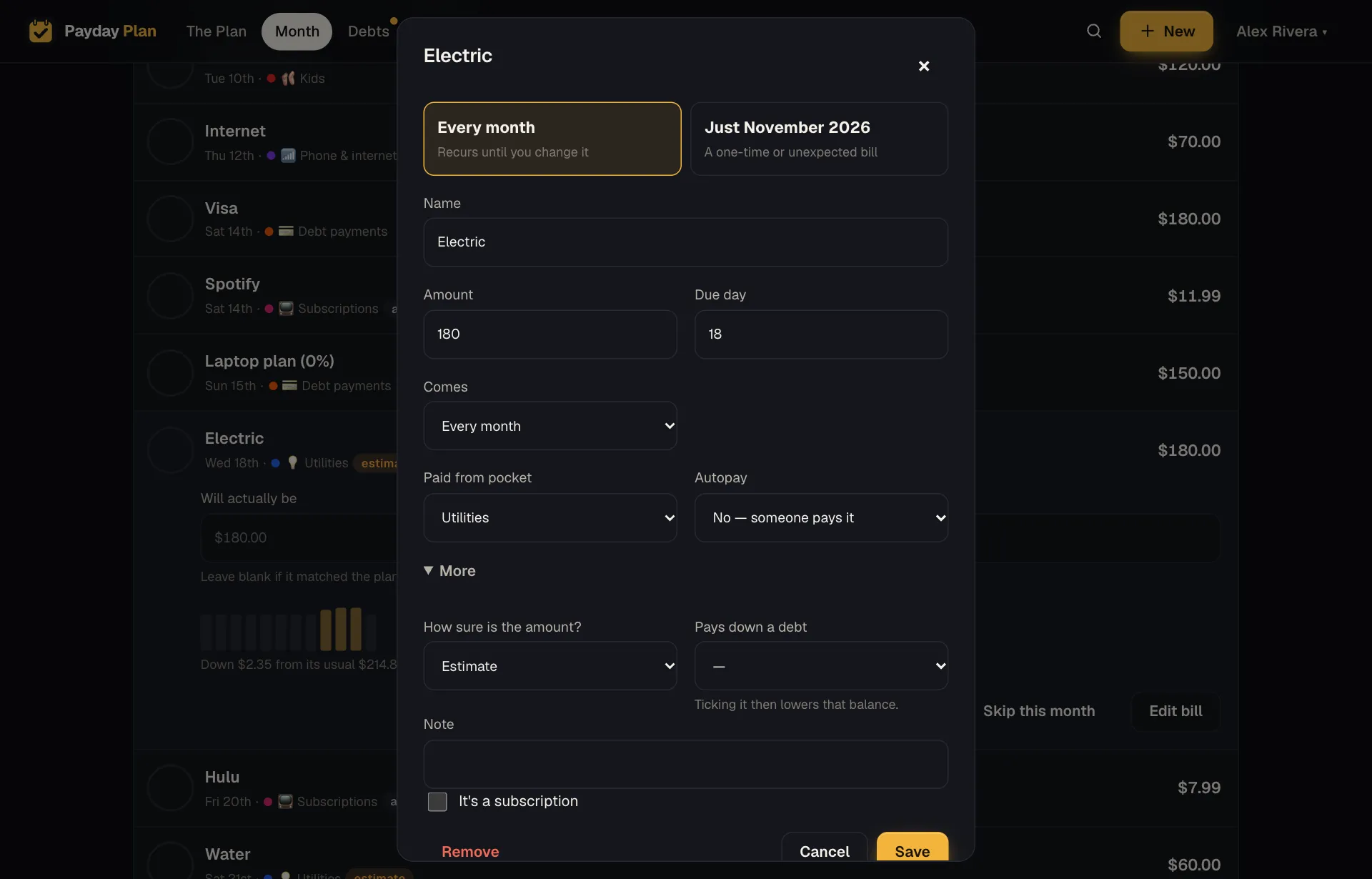
  1. Mark the guesses. On Month, tap a bill's name, then Edit bill. Under How sure is the amount?, choose Estimate and tap Save. The bill now carries an estimate tag, and The Plan's Tidy-ups card counts how many amounts are still estimates.

    The Edit bill sheet for Electric: Amount 180, Due day 18, Comes Every month, Paid from pocket Utilities, Autopay No, and under More, How sure is the amount? set to Estimate.
    Edit bill → More → How sure is the amount? Estimate tags the bill so Payday Plan knows to watch for real numbers.
  2. Record the actual each month. Pick whichever is easiest:

    • Type it into the bar at the top of The Plan, tap Go, then Read it. You'll get a This month's amount card; tap Make this change.
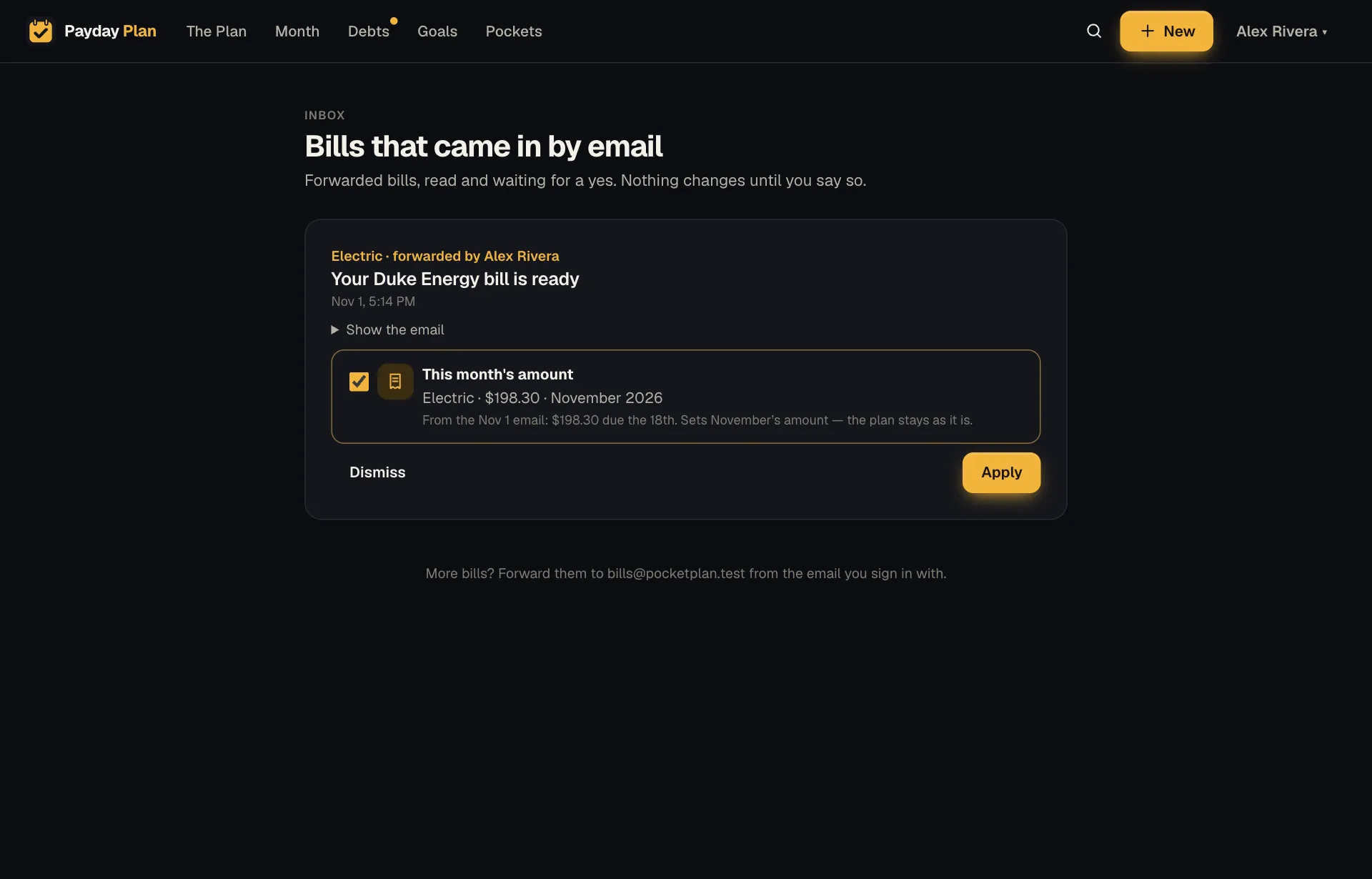
    • Forward the bill email to bills@paydayplan.app, then open Emailed bills (under your name at the top right, or More on a phone) and tap Apply.
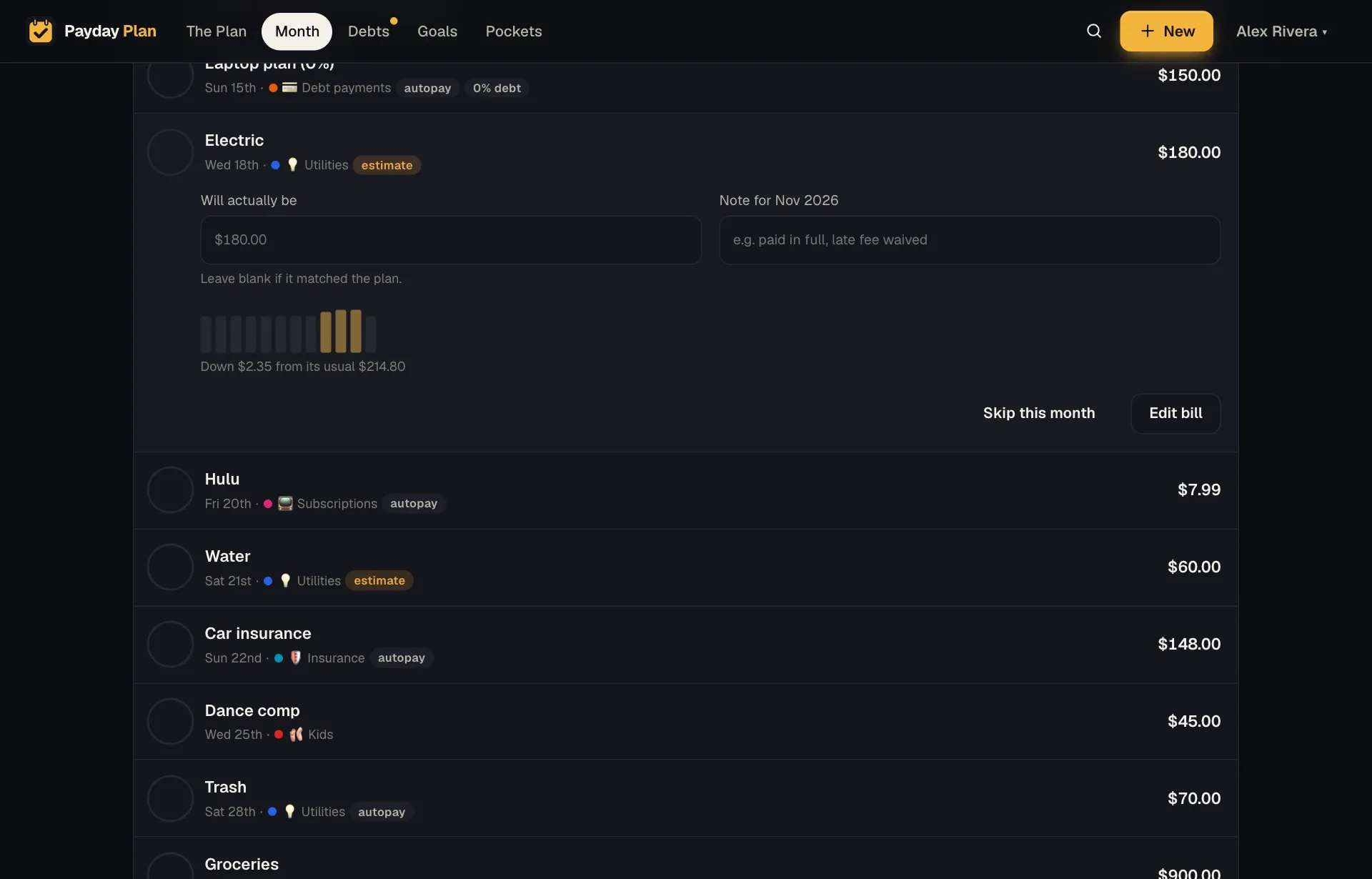
    • On Month, tap the bill's name and type the figure into Actually came out. Tap Use plan to clear it.
    The electric bill came in at $212
    The Emailed bills page with one forwarded Duke Energy email for Electric. Its ticked This month’s amount card reads Electric, $198.30, November 2026, sets November’s amount and says the plan stays as it is.
    A forwarded bill becomes This month’s amount: November gets the real number and the plan stays as it is.
  3. Leave the plan alone for now. The bill shows the real amount for this month with the planned amount in small type underneath ("plan $180.00"). Next month starts from the estimate again.

    The Month list with Electric opened: a Will actually be field, a note field for November, bars for recent months, Down $2.35 from its usual $214.80, and Skip this month and Edit bill buttons.
    Tap a bill on Month to record what it actually came to; the bars show its recent months so a new normal is easy to spot.
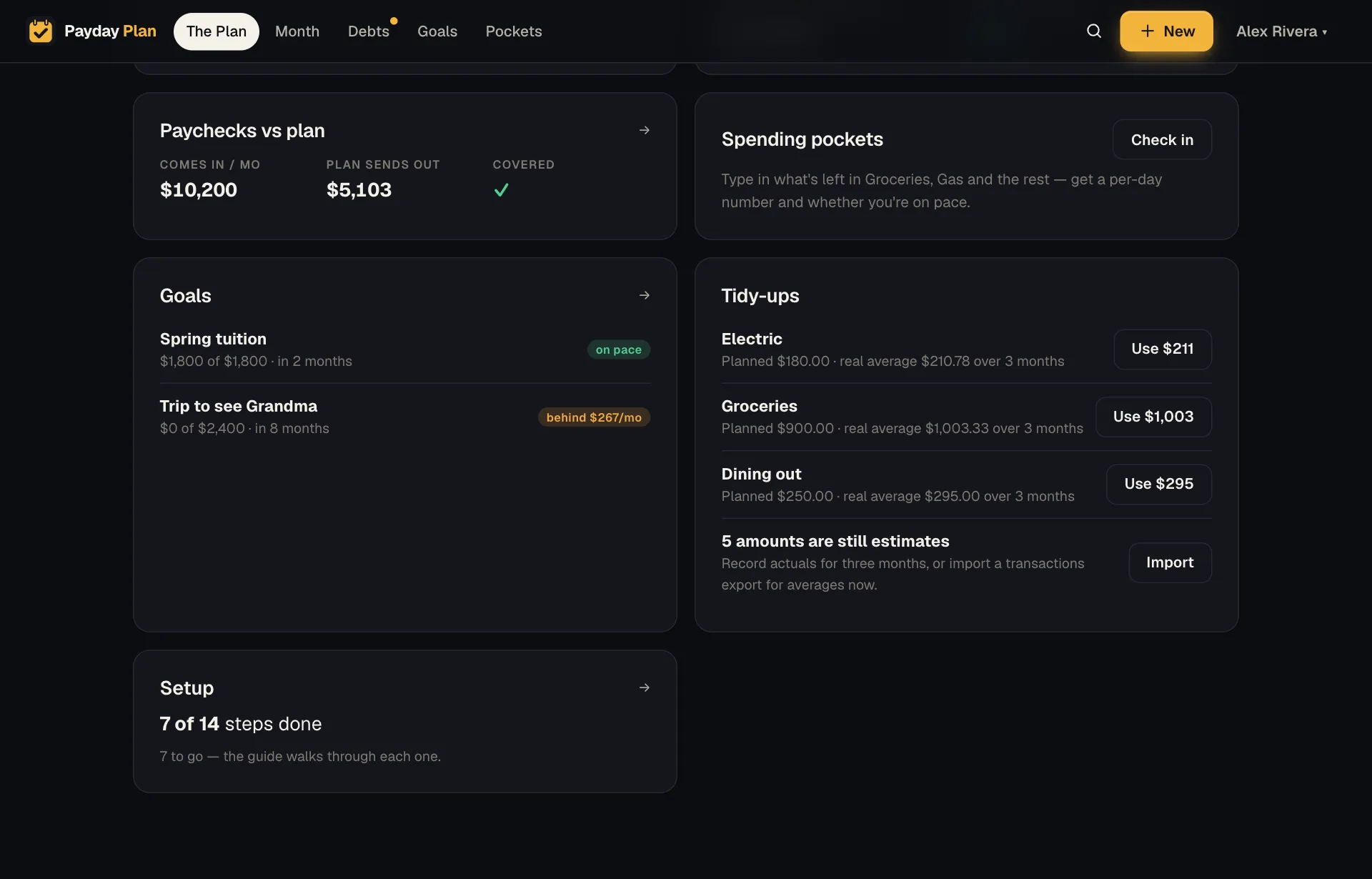
  4. After three months, take the average. Once three finished months have recorded amounts, the Tidy-ups card on The Plan lists the bill with "Planned $180.00 · real average $210.78 over 3 months" and a Use $211 button. Tap it and the average becomes the plan.

    The Tidy-ups card on The Plan: Electric planned $180.00, real average $210.78 over 3 months, Use $211; Groceries and Dining out with their averages; and 5 amounts are still estimates with an Import button.
    Tidy-ups: once three months have real amounts, one tap turns the average into the plan.
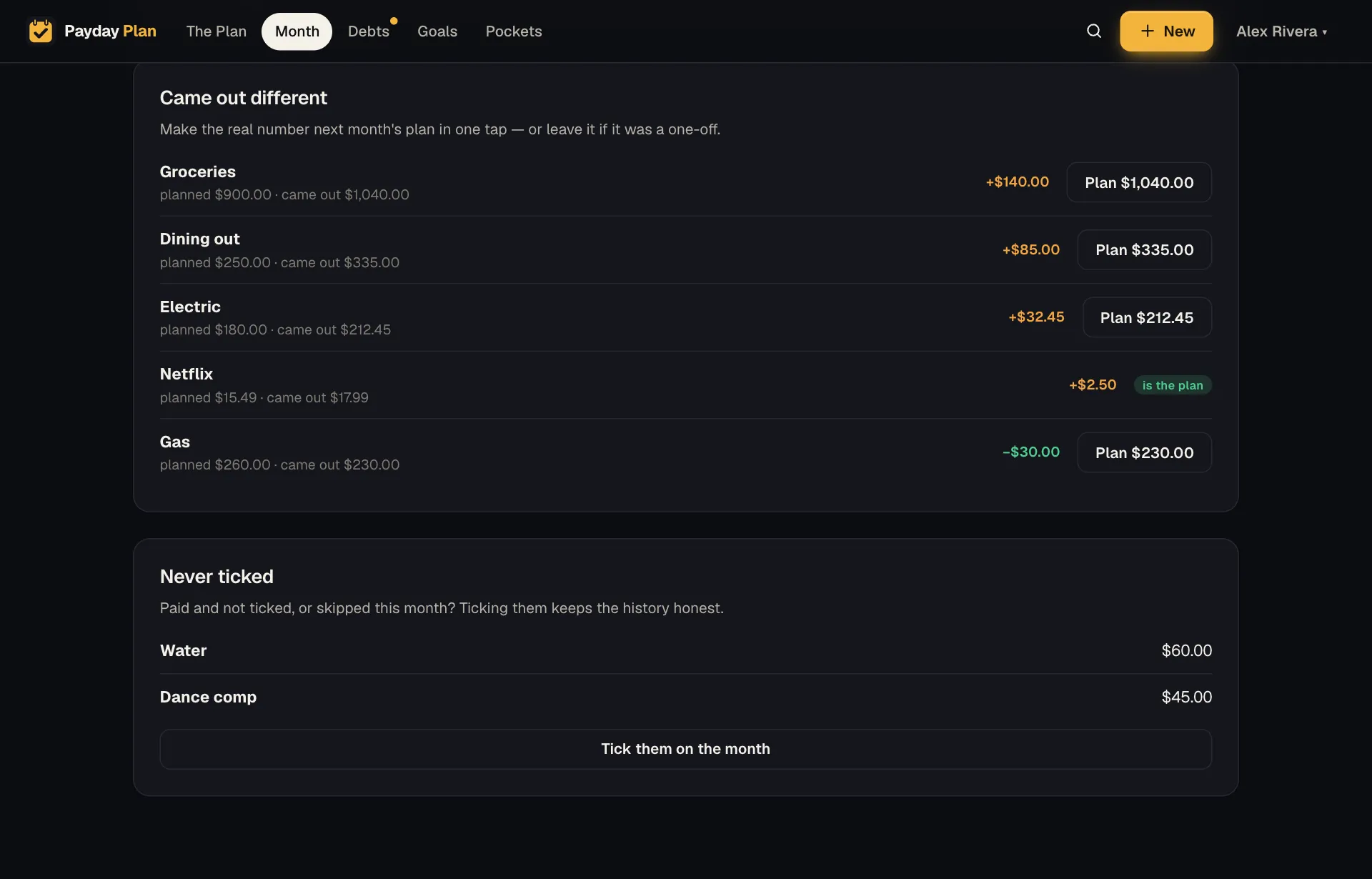
  5. Use the recap each month. Every past month has one: open Month, step back with the ‹ arrow and tap How did October 2026 go? (in the first week of a month, The Plan shows a banner for it). Came out different lists each bill whose real amount didn't match, with a Plan button to make the real number next month's plan in one tap. Never ticked shows what was planned and never marked paid.

    The recap’s Came out different section: Groceries planned $900 came out $1,040, Electric planned $180 came out $212.45 with a Plan $212.45 button, Netflix marked is the plan, Gas came in $30 under. Below, Never ticked lists Water and Dance comp.
    Came out different, in the October recap. Plan $212.45 makes one month’s real number the plan, without waiting for three.
  6. Or start with history. Open Import transactions from the same menu as Emailed bills. It reads a transactions CSV from your bank, and under Replace estimates with real averages it shows each estimate next to a 90-day merchant average, with a Use it button. Nothing from the file is stored.

Honest beats tight

There's a temptation, when you first see the gap, to keep the old estimates as a target. "We should spend $600 on groceries." Maybe. But a plan that says $600 while you spend $690 isn't a target, it's a fiction, and every number downstream of it is wrong too: what's free to spend, what's left for savings, when the debt is paid off.

Put the real number in. Then, if you want to bring it down, make that a separate decision with its own plan. You'll know whether it's working, because you'll be measuring against what's actually true.

This guide is general information about planning a household budget, not personal financial advice. Your numbers, rates and situation are your own — check the terms of your accounts before you act.

Your next payday could come with a plan.

Payday Plan is opening to households a few at a time. Ask for a spot, or sign in if you’re already in.