Most household budgets don't fail because the idea was wrong. They fail on a Sunday afternoon, about forty form fields in, when someone realises they don't know the due date for the water bill and the whole thing gets saved as a draft forever.
Setup is the hardest part of budgeting, and it's mostly friction. So here's a different approach: get the plan down roughly, in plain sentences, in ten minutes. Fill in the details as real bills arrive. A rough plan you're using beats a perfect one you never finish.
What you need before you start
Less than you think.
- Your take-home pay, and how often it arrives.
- A rough list of bills. Rent or mortgage, utilities, phone, insurance, childcare, subscriptions. If you don't know the exact amount, guess. You'll correct it later.
- Your debts: the balance, the rate and the monthly payment, roughly.
- One or two things you're saving for.
That's it. You don't need statements open, and you definitely don't need last year's spending categorised.
The ten minutes
Here's a made-up household doing it, minute by minute. They're paid $3,000 every other Friday.
Minutes 0 to 1: the paycheck. One sentence.
I get paid $3,000 every other Friday
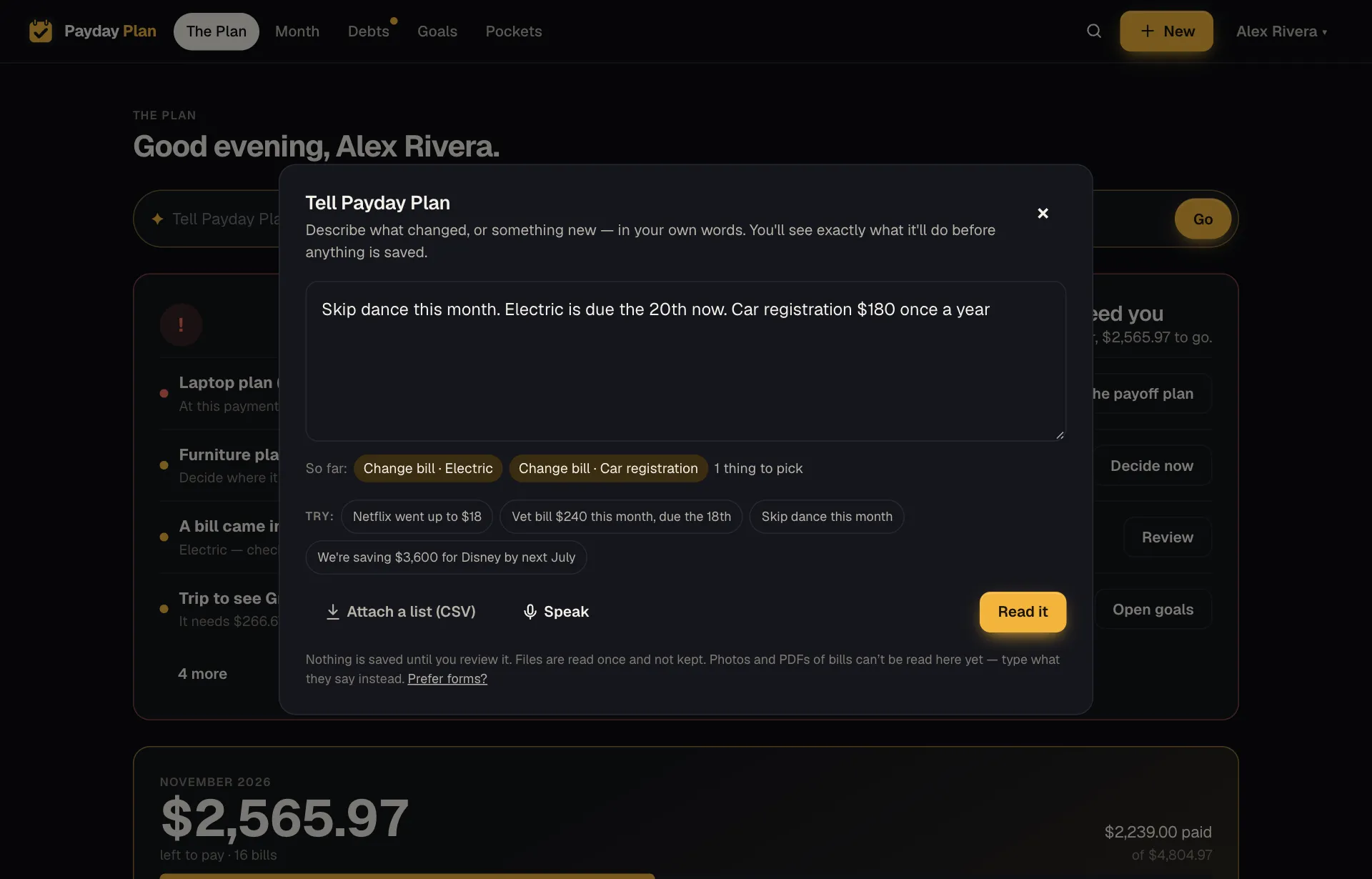
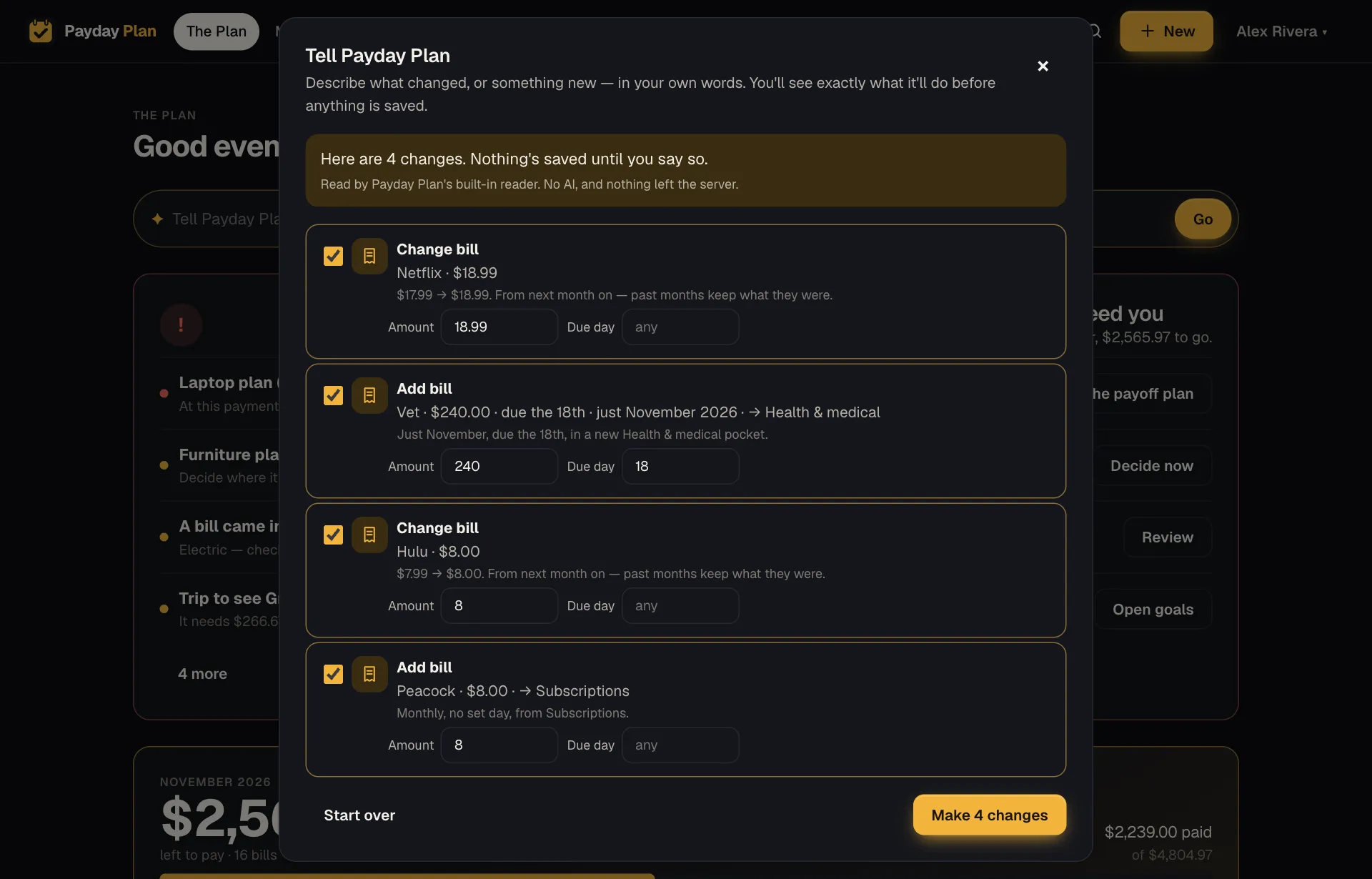
Minutes 1 to 5: the bills. Type them the way you'd say them out loud, as one list. Amounts, due days and "autopay" where it applies. Guesses are fine; say "about" if it helps you remember which ones are guesses.
Rent $1,900 on the 1st, autopay. Car payment $420 on the 6th. Electric about $140 on the 9th. Phone $120 on the 12th, autopay. Internet $80 on the 18th. Childcare $1,100 on the 26th. Car insurance $540 every 6 months.
Minutes 5 to 7: the debts. Balance, rate, payment.
Visa $4,800 at 24.99%, $150 a month on the 21st
Minutes 7 to 8: a goal.
Save $2,400 for a trip next July
Minutes 8 to 10: check it over. Read back what you've got. Is anything big missing? Does the total look roughly like what leaves the account each month? Fix anything obvious and stop.
Here's roughly what they end up with:
| Per month | |
|---|---|
| Income (26 paychecks a year ÷ 12) | $6,500 |
| Bills, including $150 to the Visa and $90 a month set aside for the six-monthly insurance | $4,000 |
| Trip goal ($2,400 over 10 months) | $240 |
| Left for groceries, gas and everyday spending | $2,260 |
Is it perfect? No. The electric is a guess, groceries haven't been planned, and the water bill is missing entirely. But the big picture is there, and it's already more useful than no plan.